
Table of Contents
How Do You Improve Training and Development in the Workplace?
You improve training and development in the workplace by doing five things well: finding out what your staff actually need, making training specific to each person’s job, using everyday work as a learning opportunity, giving honest feedback regularly, and measuring whether the training is changing behaviour. These five strategies work for businesses of every size in Nigeria from a 10-person office in Lagos to a 500-person organisation with teams across multiple states.
This article explains each strategy in plain language. It tells you what to do, why it works, and how to apply it in a real Nigerian business context. Whether you are a business owner running HR yourself or a manager trying to get better results from your team, this guide gives you a clear, practical path forward.
Why Training and Development Matter More Than Ever.
Nigerian businesses are competing harder than ever for good people. Talented employees have more choices than they did five years ago. And one of the most common reasons good staff leave their jobs is that they feel stuck. They are not learning anything new. They are not growing. And no one seems to care about their future.
That is a training and development problem. And it is one that Nigerian business owners can fix.
When you invest in your people teaching them new skills, helping them get better at what they do, preparing them for bigger roles you are doing two things at the same time. You are improving your business performance today. And you are building the leadership your business will need tomorrow.
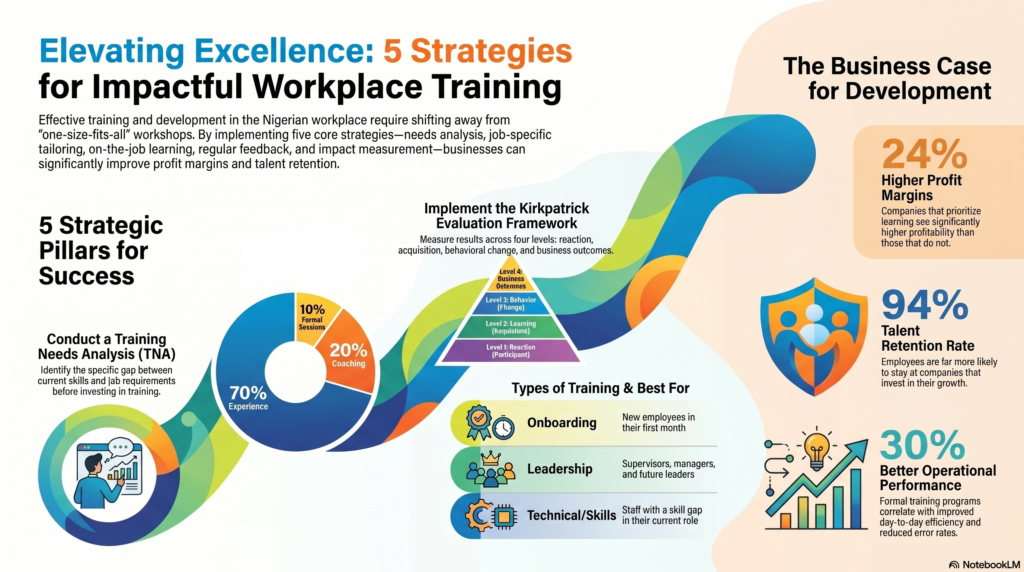
>> Companies that invest in training and development see 24% higher profit margins than those that do not — Association for Talent Development (ATD), 2023.
>> 94% of employees say they would stay at a company longer if it invested in their learning and development — LinkedIn Workplace Learning Report, 2023.
>> The Industrial Training Fund (ITF) in Nigeria found that organisations with formal training programs recorded up to 30% better operational performance than those without — ITF Annual Report, 2022.
>> A 2023 PwC Nigeria survey found that 68% of Nigerian business leaders ranked talent development as a top-three operational priority — PwC Nigeria CEO Survey, 2023.
Training and development is not a cost. It is the investment that keeps your best people, improves your results, and builds the organisation you want to lead in three years’ time.
Also read: The Differences Between Training and Development
The 6 Types of Employee Training and Development You Need to Know
Before you can improve training and development in your organisation, you need to understand what type of training you are dealing with. Not all training is the same. Each type serves a different purpose and works at a different stage of an employee’s journey.
| Type of Training | What It Teaches | Best For |
| Onboarding | Company culture, roles, and processes | New employees in their first month |
| Technical / Skills | Job-specific tools, systems, or tasks | Staff with a skill gap in current role |
| Compliance | Labour laws, policies, and safety rules | All staff, required by law in Nigeria |
| Product / Service | What the company sells and how it works | Sales, customer service, and field teams |
| Leadership | Managing people, decision-making, vision | Supervisors, managers, and future leaders |
| Refresher | Updates existing knowledge or process | Staff after a system or policy change |
Most Nigerian businesses focus almost entirely on technical and compliance training and skip everything else. The organisations that pull ahead are the ones that use all six types deliberately, matching each type to the right people at the right time.
Five Strategies to Improve Training and Development in Your Nigerian Organisation
STRATEGY 1: Find Out What Your Staff Actually Need Before You Train Them
This is the most important step and the one most Nigerian businesses skip. They book a training workshop, gather the team, and deliver a generic course. Then they wonder why nothing changed. The reason nothing changed is that the training did not match the actual need.
Think about it like going to the doctor. A good doctor does not give you medicine without first asking what is wrong. They listen, they check, and then they prescribe something specific to your problem. Training works the same way. Before you run any program, find out what your team is actually struggling with.
The best way to do this is a Training Needs Analysis (TNA). A TNA is a structured way of identifying the gap between what your staff can do now and what they need to be able to do to perform their jobs well. It involves reviewing performance data, talking to managers, and asking staff directly about the challenges they face.
What to do: Before your next training investment, have one-on-one conversations with five to ten team members. Ask them: What part of your job feels hardest? What would help you do your job better? What skill do you wish you had? Their answers will tell you exactly where to start.
A Training Needs Analysis does not need to be a formal report. Even a simple set of honest conversations with your team will give you far better information than guessing and will ensure your training budget is spent where it will make the biggest difference.
REAL BUSINESS EXAMPLE: Lagos retailer wastes N180,000 on wrong training then fixes it
A retail clothing company with 14 staff in Surulere, Lagos, ran a three-day communication skills workshop for the whole team after a difficult quarter. The owner had read that communication was the top skill gap in Nigerian workforces and assumed it was the problem. Staff attendance was good. Feedback forms were positive. But three months later, the core problem slow processing times at the point of sale had not improved at all.A subsequent conversation with four staff members revealed the real issue. The POS system had been upgraded six months earlier and three of the four cashiers were still using workarounds because no one had properly trained them on the new system. A two-hour in-house technical training session on the new POS, delivered by the system provider, resolved the problem within a week. Sales processing time dropped by 40%. The N180,000 communication training had addressed the wrong problem entirely. A brief TNA before spending would have identified the real gap immediately.
STRATEGY 2: Make Training Specific to Each Person’s Job and Level
One-size-fits-all training is one of the least effective ways to develop people. A customer service officer and a finance manager do not need the same training. A new staff member and a five-year veteran do not learn at the same pace or from the same starting point. When training is too generic, people disengage. They feel like the content does not apply to them. And they are right.
The solution is to design training that is matched to the specific role, experience level, and learning style of the person receiving it. This does not mean you need to create a different program for every individual. It means grouping people by function and level, and ensuring the training content speaks directly to the challenges they face in their actual jobs.
In Nigerian organisations, this also means being sensitive to generational differences. Younger staff may prefer interactive, digital formats. More experienced staff may prefer structured, in-person sessions with clear takeaways. A training program that ignores these differences will lose part of its audience before it even begins.
– For new hires: Focus on onboarding company culture, job responsibilities, tools, and compliance basics. Keep it practical and role-specific.
– For experienced staff: Focus on skills upgrades new tools, improved techniques, or cross-functional knowledge that expands their contribution.
– For supervisors and team leads: Focus on people management delegation, feedback, conflict resolution, and accountability.
– For senior managers: Focus on strategic skills leadership communication, change management, succession thinking, and business acumen.
The most effective training tells the participant: this program is for someone exactly like you, facing exactly this challenge, in a workplace exactly like yours. The more specific it is, the more it sticks.
STRATEGY 3: Use Everyday Work as a Learning Opportunity
Not all training happens in a workshop. In fact, research consistently shows that most of what people learn at work comes not from formal training sessions, but from doing their jobs making decisions, solving problems, working with colleagues, and learning from mistakes.
This is sometimes called on-the-job learning. It is one of the most powerful and cost-effective development tools available, and most Nigerian businesses are not using it deliberately.
Here is a simple example. A junior sales officer makes a pitch to a client and it does not go well. The manager debrief afterward asking what happened, what could have been different, and what the officer will do differently next time is a learning moment. It costs nothing. It is immediately relevant. And it is far more memorable than a generic sales training workshop.
Stretch assignments: Give a high-potential staff member a task that is slightly beyond their current comfort zone. A junior accountant who is being developed for a senior role might be asked to prepare a budget presentation for management. The stretch builds capability in a real context.
Cross-departmental exposure: Rotating staff through different teams for short periods gives them a broader understanding of how the business works essential for anyone being prepared for management or leadership.
Mentoring and shadowing: Pairing a less experienced person with a more senior colleague is one of the oldest and most effective development methods in existence. It costs almost nothing and produces lasting results.
Debriefs after key events: After a big project, a client presentation, or a difficult situation, gather the team and ask three questions: what went well, what could have been better, and what will we do differently next time? This turns every significant event into a development opportunity.
>> Research by the Center for Creative Leadership found that 70% of professional learning happens through on-the-job experience, 20% through coaching and feedback, and only 10% through formal training programs the 70-20-10 model CCL, 2023.
STRATEGY 4: Give Regular, Honest, and Constructive Feedback
Feedback is one of the most powerful tools for improving performance and development and one of the most poorly used in Nigerian organisations. Many managers give feedback only during the annual performance review. Some avoid giving difficult feedback entirely because they do not want to upset their staff. Others give feedback in a way that feels more like criticism than coaching.
None of these approaches work. Feedback that comes once a year is too late. Feedback that is avoided leaves the person repeating the same mistakes. And feedback that attacks the person rather than the behaviour creates defensiveness rather than growth.
Good feedback is specific, timely, and focused on behaviour and outcomes not personality. It tells the person what they did, what effect it had, and what they could do differently. It is a conversation, not a lecture.
Specific: Do not say ‘your work is not good enough.’ Say ‘the monthly report you submitted was missing the variance analysis in section three. Let us look at that together.’
Timely: Give feedback as close to the event as possible. Waiting weeks or months reduces the relevance and the impact.
Two-directional: Ask the person for their view first. What do they think went well? What would they do differently? This turns feedback from a verdict into a dialogue.
360-degree feedback: For senior staff, consider gathering feedback from peers, direct reports, and managers not just the line manager. This gives a fuller picture and reduces the risk of blind spots on both sides.
In Nigerian organisations where hierarchical culture can make honest feedback feel risky, building a feedback-safe environment is one of the most important things a manager can do. It signals that growth is welcomed, that mistakes are learning opportunities, and that the organisation is invested in each person’s development.
STRATEGY 5: Measure Whether Training Is Actually Working
Most Nigerian businesses run training and never check whether it changed anything. The facilitator leaves, the certificates are issued, and life goes on exactly as before. If you are spending money on training and development without measuring the impact, you are not managing a learning investment you are managing a cost.
Measuring training effectiveness does not need to be complicated. There are four simple levels you can assess:
– Level 1 — Reaction: Did the participants find the training useful and relevant? A short feedback form at the end of the session tells you this. If people consistently say the training was not relevant to their work, the content needs to be redesigned.
– Level 2 — Learning: Did the participants actually learn something? A short pre-and-post knowledge check or skills assessment tells you whether the training content landed. This is different from whether people enjoyed the day.
– Level 3 — Behaviour: Are participants applying what they learned in their work? Check in with their managers 30 and 60 days after the training. Ask whether the trained behaviours are showing up on the job.
– Level 4 — Results: Is the training making a measurable difference to business outcomes? Look at the metrics that the training was designed to improve customer satisfaction scores, error rates, sales figures, or staff retention and assess whether they have moved.
This four-level framework is known as the Kirkpatrick Model and it is the standard evaluation approach used by professional training organisations globally. You do not need to apply all four levels to every program. But applying at least Levels 1 and 3 to every training investment gives you the information you need to keep improving.
>> SHRM research found that only 35% of organisations regularly measure the business impact of their training programs. Those that do report 2.5 times higher training ROI than those that measure only participant satisfaction — SHRM, 2023.
Also read: Top 5 HR Services for Small Businesses in Nigeria,
The Value of Background Checks for HR Management
Common Training and Development Mistakes Nigerian Businesses Must Avoid
– Running training once and expecting permanent change. A single session does not change deeply held habits or behaviours. Learning needs reinforcement. Follow up training with coaching, practice opportunities, and check-in conversations to make the change stick.
– Choosing a training provider based on price alone. A cheap training program that produces no behaviour change costs the same as doing nothing except you also spent the money. Assess providers on their track record, their ability to customise content, and their understanding of the Nigerian business context.
– Training everyone on everything at the same time. Not everyone in your organisation has the same gap. Sending the whole company to the same workshop when only some people have the relevant need wastes time and disengages the people who do not need it.
– Skipping the follow-up. Research consistently shows that without reinforcement, people forget up to 70% of what they learned in a training session within a week. Build follow-up into every program from the start.
– No link between training and career development. When staff do not understand why they are being trained or what it means for their future, they do not engage fully. Connect training to a clear development path and communicate that connection explicitly.
– Leaving development to chance. High-potential employees do not develop themselves automatically. Development happens when someone invests deliberate time, attention, and resources in it. If you are hoping your best people will grow without a plan, you are also hoping they will not leave for a company that does have one.
What Better Training and Development Does for Your Business
When you improve training and development in your workplace, the benefits show up quickly and they compound over time. Here is what consistently investing in your people delivers:
– Better performance across the team. Staff who are trained well make fewer mistakes, work faster, and serve customers more effectively. The impact on day-to-day output is immediate and measurable.
– Lower staff turnover. People stay where they feel they are growing. Investing in your team’s development is one of the most effective retention tools available and significantly cheaper than replacing good people.
– A stronger leadership pipeline. Development programs identify and prepare your next generation of managers and leaders. Businesses that grow their own leaders are more stable and more resilient than those that rely entirely on external hiring.
– ITF reimbursement. Nigerian businesses with five or more employees that comply with the Industrial Training Fund levy can recover qualifying training expenditure through the ITF reimbursement scheme. This reduces the net cost of training investment.
– A better reputation as an employer. In Lagos’s competitive job market, businesses known for investing in their people attract better candidates. Word travels fast. Your training culture is part of your employer brand.
Frequently Asked Questions
What is training and development in the workplace?
Training and development in the workplace refers to all the activities an organisation uses to improve the skills, knowledge, and performance of its employees. Training focuses on current job skills. Development focuses on preparing employees for bigger roles in the future. Both are essential for business growth.
What are the four types of employee training?
The four most commonly referenced types of employee training are onboarding training (for new hires), technical or job-specific training (for current role performance), leadership and management training (for those moving into or already in supervisory roles), and compliance training (to meet legal requirements). In practice, most organisations also use refresher training and product or service training.
How do you identify training needs in a Nigerian organisation?
Identify training needs by reviewing performance data, observing where mistakes or inefficiencies are occurring, speaking to managers and staff about their challenges, and comparing current skills against the skills required for each role to perform well. This process is called a Training Needs Analysis (TNA).
How much does workplace training cost in Nigeria?
Training costs in Nigeria vary by topic and group size. A one-day workshop for a team of 10 to 20 staff typically costs between N75,000 and N400,000. Leadership and development programs delivered over multiple weeks cost more. Businesses registered with the ITF may be eligible to recover a portion of qualifying training costs through the reimbursement scheme.
How do you measure the effectiveness of training in the workplace?
Use the Kirkpatrick four-level model. Level 1 measures participant reaction (did they find it useful). Level 2 measures learning (did they actually learn something new). Level 3 measures behaviour change (are they applying it on the job). Level 4 measures business results (have the target metrics improved). Most organisations should measure at least Levels 1 and 3 for every program.
How often should Nigerian businesses run staff training?
There is no single answer. Compliance training should be refreshed annually or whenever the law changes. Skills and technical training should be delivered when a gap is identified or a new tool or process is introduced. Leadership development is typically a structured program running over several months. The best organisations build a regular training calendar rather than reacting only when there is a crisis.
Can Anthrop Management Limited help us improve training and development in our organisation?
Yes. Anthrop Management Limited designs and delivers training and development programs for organisations across Lagos and Nigeria. We conduct Training Needs Analyses, design customised programs for specific roles and levels, deliver in-person and hybrid workshops, and provide post-training support to reinforce learning. Contact us today to discuss your team’s needs.
Improve Training and Development in Your Organisation Today
Our team at Anthrop Management Limited designs and delivers practical training and development programs for businesses across Lagos and Nigeria. From onboarding and compliance training to leadership development and soft skills workshops, we build programs around what your team actually needs.
Learn more about our human resource management and training services in Lagos, Nigeria. We also provide HR consulting, recruitment, payroll management, and compliance support.
Conclusion: Better Training and Development Builds a Better Business
Improving training and development in your workplace is not complicated. It requires five things done consistently: finding out what your staff actually need, matching training to the right people and roles, using daily work as a learning tool, giving honest feedback regularly, and measuring whether your investment is working.
None of these require a large budget. They require intention, discipline, and a genuine belief that your people are worth investing in. In Nigeria’s competitive business environment, that belief is the difference between organisations that keep growing and those that keep replacing people.
Start with one conversation. Ask your best team member what would help them do their job better. That conversation is the beginning of a training and development culture that will serve your business for years to come.
Anthrop Management Limited is ready to help you build that culture. Contact us today.
References
1. Association for Talent Development (ATD) — State of the Industry Report 2023
2. LinkedIn Workplace Learning Report 2023
3. Industrial Training Fund (ITF) Nigeria — Annual Report 2022
4. PwC Nigeria — CEO Survey: Talent and Leadership 2023
5. Center for Creative Leadership — 70-20-10 Learning Model Research
6. SHRM — Training Measurement and ROI Research 2023
7. Kirkpatrick Partners — The Kirkpatrick Model
8. Gallup — State of the Global Workplace Report 2023
9. McKinsey & Company — Learning and Development Effectiveness 2023
10. Industrial Training Fund Act Cap I9, Laws of the Federation of Nigeria 2004