
Table of Contents
If you run a business in Nigeria and you want your team to perform better, you have probably heard the words training and development. But do you know what they actually mean? And do you know the difference between the two?
Many business owners use these two words like they mean the same thing. They do not. Understanding the difference between training and development is one of the most important things you can do to grow your business and build a stronger team.
In this article, we will break everything down in simple language. No big grammar. No confusion. Just clear, practical advice that works for your business in Nigeria whether you run a startup in Lagos, a manufacturing company in Kano, or a retail shop in Abuja.
What Is Training? (The Simple Answer)
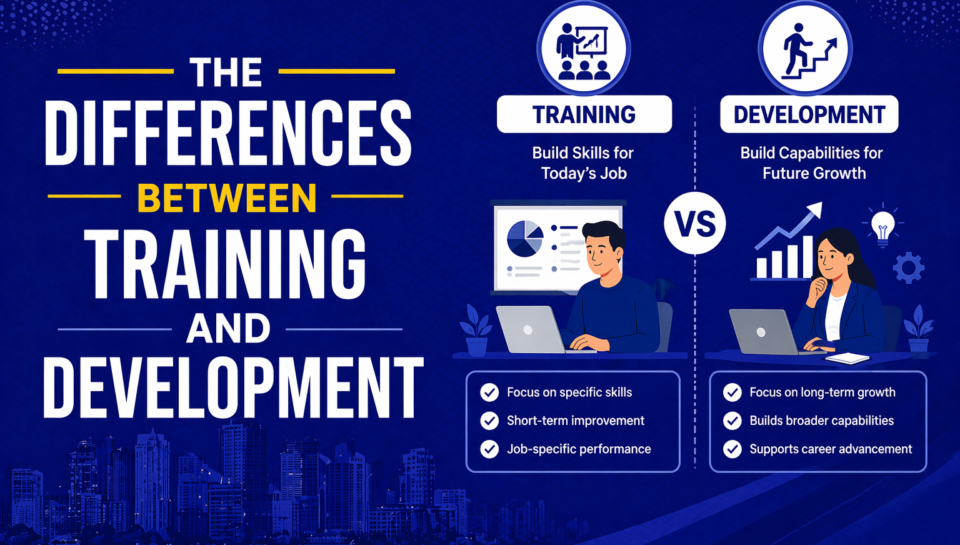
Training is teaching someone how to do a specific job or task right now.
Think of it this way. You just hired a new customer service rep at your Lagos store. She has never used your point-of-sale (POS) machine before. You sit her down and show her how to process payments, how to handle complaints, and how to greet customers the right way. That is training.
Training is short-term. It is focused. It solves an immediate problem. It answers the question: “What does this person need to know to do their job today?”
Here are common examples of training in Nigerian businesses:
- Teaching a new accountant how to use your QuickBooks software
- Showing factory workers in Aba how to operate new machinery safely
- Training your sales team on a new product you just launched
- Teaching your receptionist how to handle client calls professionally
Training is practical. It is skills-based. And it usually has a beginning and an end.
What Is Development? (Going Deeper)
Development is different. Development is about growing a person over time so they can take on bigger responsibilities in the future.
Development is long-term. It is not about one skill or one task. It is about building the whole person their thinking, their leadership, their problem-solving ability, and their career growth.
Let us use a real Nigerian example. Imagine you have a brilliant young sales officer at your company in Port Harcourt. She is great at her job. You want her to become a sales manager in the next two years. So you start giving her leadership tasks. You send her to a management programme. You assign her a mentor. You let her sit in on strategy meetings. All of this is development.
Development answers a different question: “Who does this person need to become to lead and grow with this company in the future?”
Here are common examples of development in Nigerian organisations:
- Mentoring a junior HR officer to become a future HR Manager
- Enrolling promising staff in leadership or MBA programmes
- Giving a talented team member cross-departmental projects to build broad skills
- Coaching an employee on emotional intelligence and communication
Development takes months or years. But it creates something very powerful loyal, capable employees who grow with your business.

The Key Differences Between Training and Development
Let us put it side by side so it is crystal clear.
| Training | Development | |
|---|---|---|
| Focus | Specific skill or task | Overall growth of the person |
| Timeframe | Short-term | Long-term |
| Goal | Fix a current gap | Prepare for future roles |
| Who leads it | Supervisor, trainer, or vendor | Manager, mentor, or the employee themselves |
| Example | Teaching a new driver your delivery routes | Grooming that driver to become a logistics manager |
Both are important. You cannot choose one and ignore the other. A smart Nigerian business runs both together.
Why Training and Development Matter for Nigerian Businesses
Let us be honest. Nigeria has a talent problem. Not because good people do not exist they do. But many businesses are losing great employees to competitors, international companies, or remote work opportunities abroad.
The businesses that win are the ones that invest in their people.
Here is what the data tells us globally: companies that invest in employee training and development see higher productivity, lower staff turnover, and stronger business results. And in Nigeria, where skilled talent is hard to retain, this is even more important.
Think about it from your employee’s point of view. If you work for a company that teaches you nothing and keeps you stuck in the same role for three years, what will you do? You will leave. You will find a company that helps you grow.
But if your company trains you properly, develops your career, and invests in your future you become loyal. You stay. You give your best.
That is the real ROI (Return on Investment) of training and development.
Subscribe to get exclusive insights you won’t find anywhere else.
How Training and Development Work Together
Here is something many business owners in Nigeria get wrong. They think training and development are two separate programmes that never touch. They are not. The best organisations design them to work together.
Here is how it looks in practice:
Step 1 — Identify the gap. You notice that your sales team is not closing enough deals. That is a gap. Training will address the immediate problem (closing techniques, product knowledge, objection handling).
Step 2 — Look at the bigger picture. You also notice that one of your sales reps has great potential. She is sharp, motivated, and wants to grow. You put her on a development track coaching, leadership exposure, and a plan to move her into management in 18 months.
Step 3 — Review and adjust. Every six months, you review. Is the training working? Is the development plan on track? You adjust based on real results.
This is how smart companies in Nigeria build strong teams from the inside out.
A Real Nigerian Business Scenario
Let us bring this to life with a story.
The Problem: Mr. Chukwuemeka owns a medium-sized logistics company in Onitsha with 45 staff members. He keeps hiring new drivers, but within six months, many of them either leave or make costly mistakes on delivery routes. His warehouse staff are disorganised and his supervisors struggle to manage their teams. The business is growing, but the people are not growing with it.
The Mistake: Mr. Chukwuemeka thought giving employees a salary was enough motivation. He never invested in training or development. No onboarding for new drivers. No coaching for supervisors. No career growth plan for anyone.
The Solution: He contacted an HR consulting firm who helped him design a simple training and development plan:
- New Driver Onboarding Training. A structured 2-week training programme covering route knowledge, vehicle handling, customer interaction, and safety procedures.
- Warehouse Operations Training. A monthly skills refresher for warehouse staff on inventory management and safety.
- Supervisor Development Programme. Quarterly coaching sessions for supervisors on people management, conflict resolution, and team leadership.
- Career Pathways. A simple document showing every employee what growth looks like at the company from driver to senior driver to fleet coordinator to logistics supervisor.
The Result: Within 12 months, staff turnover dropped. Delivery errors reduced. Supervisors became more confident. And three junior employees were promoted internally saving the company the cost of external recruitment.
That is the power of training and development done right.
The Benefits of Investing in Training and Development
Still not convinced? Here is what your business gains when you take training and development seriously.
1. Higher Productivity Employees who are properly trained waste less time making mistakes. They work faster, smarter, and with more confidence.
2. Lower Staff Turnover Replacing an employee in Nigeria costs money recruitment, onboarding, lost productivity. When you invest in your people, they stay longer.
3. Better Customer Experience Trained staff deliver better service. Whether it is a customer service rep at your Lagos office or a technician handling field work in Abuja, training shows in how they treat your customers.
4. Stronger Internal Leadership Development builds future managers and leaders from within your own team. You do not always have to hire from outside. You grow your own leaders.
5. Competitive Advantage Businesses with well-trained teams outperform those without. In Nigeria’s competitive market, your people are your biggest advantage.
6. Better Company Culture When employees see that you care about their growth, they care more about the company’s growth. A culture of learning creates loyalty, innovation, and team spirit.
Common Mistakes Nigerian Businesses Make With Training and Development
Many companies in Nigeria make these mistakes. Let us make sure you avoid them.
Mistake 1: Treating training as a one-time event. You send your team for a workshop in January and forget about it by March. Training only works when it is continuous. One session is not enough.
Mistake 2: Training everyone the same way. A new graduate needs different training from a 10-year veteran. Personalise your approach based on the person, the role, and the gap you are trying to close.
Mistake 3: Confusing training with development. Some business owners think sending someone for a course is “development.” That is training. Development is a longer, more intentional journey. Do not mix them up.
Mistake 4: No follow-up after training. An employee attends a great sales training. They come back to the office excited. But no one follows up, no one reinforces what they learned, and within three weeks, it is forgotten. Always follow up.
Mistake 5: Skipping onboarding training for new hires. Many Nigerian businesses throw new employees into the deep end without proper orientation. This leads to early mistakes, frustration, and quick resignations. Onboarding training is not optional.
Mistake 6: Developing only senior staff. Development is not just for managers and directors. When you invest in your junior staff early, you build a pipeline of future leaders who already understand your company’s values and culture.
Subscribe to get exclusive insights you won’t find anywhere else.
Frequently Asked Questions (FAQs)
What is the difference between training and development?
Training teaches a person how to do a specific task or skill right now. Development focuses on growing a person over time so they can take on bigger roles in the future. Training is short-term. Development is long-term.
Why is training and development important for businesses in Nigeria?
Nigeria’s job market is competitive. Skilled employees have many options. Businesses that invest in training and development retain better staff, improve performance, reduce costly mistakes, and build stronger teams from within.
How much does training and development cost in Nigeria?
The cost varies widely. Simple in-house training can cost very little just the time of a senior staff member. Formal training programmes or third-party vendors may cost between ₦50,000 and ₦500,000+ depending on the number of staff and the programme. Development coaching and mentoring programmes vary based on scope. A good HR consulting firm can help you design a cost-effective plan that fits your budget.
Who needs training and development in a company?
Everyone. From the newest intern to the most senior manager. Every person in your organisation has room to grow. The type and level of training and development will differ, but no one is too experienced to keep learning.
How do I start a training and development programme for my business?
Start by identifying your gaps. Where is your team struggling? What skills are missing? Then decide who needs training and who is ready for a development plan. You can work with an HR consultant to design a programme that fits your company size, budget, and goals. You do not need a big budget to start, start small, be consistent, and build from there.
What is the difference between training and development in human resource management (HRM)?
In HRM, training refers to structured programmes that improve current job performance. Development refers to broader programmes that prepare employees for future responsibilities. HR professionals design both to align with the company’s business goals and people strategy.
Conclusion: You Cannot Afford to Ignore This
Here is the bottom line. If you want your Nigerian business to grow, your people must grow with it. And that only happens when you take training and development seriously.
Training gives your team the skills they need today. Development builds the leaders you will need tomorrow. Together, they create a workforce that is capable, loyal, and motivated to help your business win.
The companies that dominate in Nigeria over the next decade will not just be the ones with the best products or the most funding. They will be the ones with the best people and the best people come from organisations that invest in growing them.
Start small if you have to. But start today.
Learn more about our human resource services in Lagos, Nigeria from recruitment and HR strategy to staff training and compliance support.
Our team provides HR consulting, recruitment, payroll, and compliance support for businesses across Nigeria. Whether you are a small business in Abuja or a growing company in Lagos, we can help you design a training and development programme that fits your goals and your budget.
Contact us today to get started and let us help you build the team your business deserves.