

Table of Contents
So you are thinking about switching careers. Maybe you have spent years in a job that no longer excites you. Maybe the industry changed and left you behind. Or maybe you just woke up one day and thought, “There must be something better than this.”
Here is the truth: learning how to switch careers in your 30s and 40s is one of the smartest things you can do for your future. It is not too late. It is not too risky. And you are not the first person to feel this way.
In Nigeria, more professionals than ever are making bold career moves. From bankers becoming tech entrepreneurs to civil servants turning into consultants, the shift is real and it is growing. This guide will show you how to do it the right way without losing your savings, your confidence, or your mind.
Whether you are 32 or 47, this article will walk you through everything you need to know.
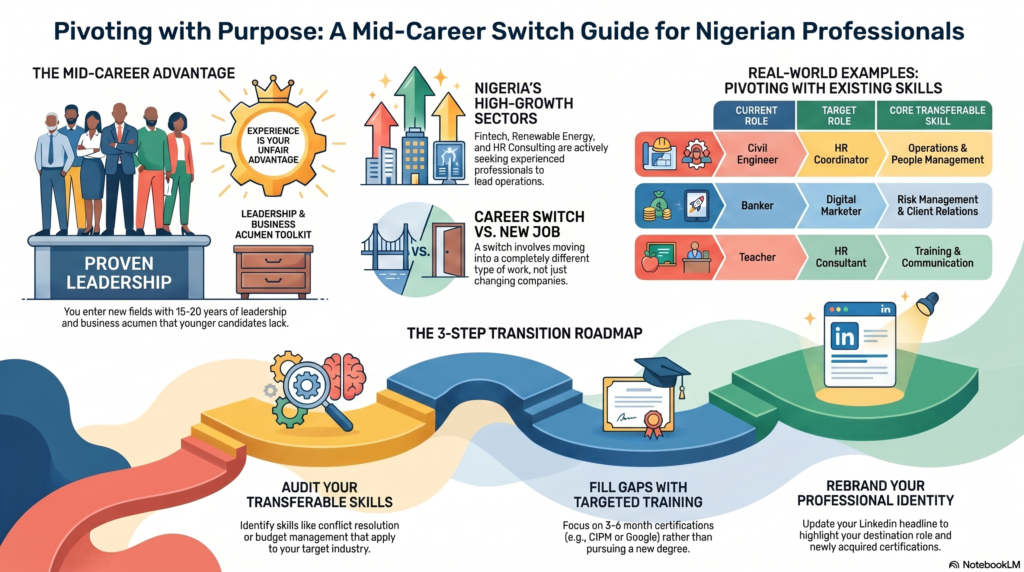
What Does Switching Careers Actually Mean?
Switching careers is different from just getting a new job. A new job means doing the same kind of work for a different company. Switching careers means moving into a completely different type of work.
For example:
- A banker who becomes a digital marketer is switching careers.
- A teacher who becomes an HR consultant is switching careers.
- An engineer who becomes a product manager is switching careers.
It sounds scary. But here is the good news, you are not starting from zero. You are starting with years of skills, connections, and experience. You are just pointing them in a new direction.
Why Nigerians Are Switching Careers in Their 30s and 40s
The Nigerian job market has changed a lot in the last ten years. Old industries are shrinking. New ones are growing fast. Here are some real reasons people are making moves:
1. Burnout is real. A lot of Nigerians have been grinding in the same industry for over a decade. They are tired. Not lazy,just tired of work that does not feel meaningful anymore.
2. Technology has changed everything. Industries like banking, oil and gas, and even education are automating. Some jobs that existed five years ago are gone. People need to adapt or get left behind.
3. Better opportunities are available now. The rise of remote work, tech startups, digital businesses, and global freelance platforms has opened doors that did not exist before. A Nigerian professional can now work for a company in the UK from Lagos or Abuja.
4. The need for more income. Nigeria’s economy puts pressure on workers. A salary that felt okay in 2015 barely covers rent now. Switching to a higher-paying industry is a survival move for many families.
Also read: Training and Development in Human Resource Management.
Is It Too Late to Switch Careers at 35, 40, or 45?
Short answer: No. Long answer: Still no, and here is why.
The biggest lie people tell themselves is, “I am too old to start again.” But age is not the barrier. Fear is the barrier.
Think about it this way. A 40-year-old professional who switches careers does not start at the bottom. They walk into a new field with 15 to 20 years of work experience. They know how to handle pressure. They can lead a team. They understand how businesses work. Younger candidates cannot match that, not yet.
Many of the most successful entrepreneurs and leaders in Nigeria did not find their best career until their 30s or 40s. Former bankers who became startup founders. Former civil servants who became business consultants. Former teachers who became child development experts.
You are not too late. You are actually perfectly on time.
Step-by-Step Guide: How to Switch Careers in Your 30s and 40s
Here is a practical roadmap you can follow. Take it one step at a time.
Step 1: Get Honest With Yourself
Before you do anything else, ask yourself these questions:
- What do I actually enjoy doing every day?
- What am I naturally good at?
- What kind of work drains me?
- What would I do if money were not the main concern?
Write down your answers. Do not rush this step. This is the foundation of everything else.
If you are not sure, talk to an HR consulting professional. A good HR consultant in Nigeria can help you do a proper career assessment. They help you see what careers match your strengths, not just what is popular right now.
Step 2: Research Your New Career Direction
Once you have an idea of where you want to go, research it properly.
Ask yourself:
- Is there demand for this career in Nigeria?
- What skills do I need?
- What does a typical career path look like?
- How much do people earn at entry, middle, and senior levels?
Use LinkedIn to look at real people who are already doing that job. See their background. See how they got there. This is free research that most people ignore.
Step 3: Identify Your Transferable Skills
This is the part most career changers miss. You already have skills that work in your new field. You just have not packaged them correctly yet.
For example:
- A teacher in Nigeria who wants to move into HR consulting already knows how to train people, manage groups, communicate clearly, and give feedback. Those are core HR skills.
- A banker who wants to move into financial consulting already understands numbers, risk, client management, and compliance, including payroll compliance in Nigeria.
Make a list of your top ten skills. Then match them to what your new industry needs. You will be surprised how much you already bring to the table.
Step 4: Fill the Gaps With Training
You will not have every skill for the new career, and that is okay. The goal is to fill the key gaps.
In Nigeria, you have several affordable options:
- Online courses on platforms like Coursera, Udemy, and LinkedIn Learning
- Short certificate programs at universities and professional bodies like CIPM (Chartered Institute of Personnel Management)
- Bootcamps for tech, digital marketing, or data skills
- Professional mentorship from people already in your target field
You do not need to spend five years getting another degree. A focused three to six month learning plan can be enough to get you started.
Step 5: Update Your Resume and LinkedIn Profile
Your resume needs a makeover. Not because your experience is bad, but because it needs to speak to a new audience.
Here is how to do it:
- Write a short professional summary that explains your career pivot clearly
- Lead with your transferable skills, not just your old job titles
- Highlight any new training or certifications you have completed
- On LinkedIn, update your headline to reflect where you are going, not just where you have been
For example, instead of “Banker with 12 years experience,” your new headline could be: “HR & People Operations Professional | Transitioning from Finance | CIPM Certified.”
Step 6: Build the Right Connections
You cannot switch careers alone. You need people who are already in the field to open doors for you.
In Nigeria, this means:
- Attending industry events and professional meetups
- Joining relevant WhatsApp and LinkedIn groups
- Reaching out to people for informational interviews (just a 20-minute chat to learn from them)
- Working with a recruitment or HR consulting firm that specializes in career transitions
Connections lead to opportunities that are never posted online. Many of the best jobs in Nigeria are filled through referrals. Build relationships before you need them.
Step 7: Be Open to Transition Roles
You may not land your ideal job on day one, and that is completely fine.
Consider taking a step that gets you into the industry first:
- A junior or entry-level role in your new field
- A consulting or freelance project to build your portfolio
- A volunteer or part-time role while still at your current job
- A contract position through an HR or staffing agency in Nigeria
These transition roles are not steps backwards. They are bridges. They give you experience, references, and proof that you can do the work.
Also read: Top 5 HR Services for Small Businesses in Nigeria
A Real Nigerian Example: From Engineer to HR Consultant
Let us look at a scenario that happens more than you think.
The Situation: Tunde is 38 years old. He works as a civil engineer in Abuja. He has been in construction for 12 years. The work is good but it is no longer growing. He wants to move into HR and organizational development.
The Problem: Tunde has no HR certification. His resume is full of engineering projects. He does not know anyone in HR. He feels stuck.
The Solution: Tunde did a skills assessment and realized he had been managing teams, running training for new site workers, handling conflict resolution, and managing budgets, all core HR functions. He enrolled in a six-month CIPM certification program. He updated his LinkedIn to highlight his people management experience. He reached out to an HR consulting firm in Nigeria for guidance. Within eight months, he landed a role as an HR coordinator at a construction company that needed someone who understood both people and operations.
Tunde did not start over. He pivoted, and he did it with a plan.
Benefits of Switching Careers at the Right Time
Changing careers is not just about escaping a bad job. When done well, it creates real benefits:
- Higher earning potential in a growing industry
- More job satisfaction doing work that actually interests you
- Better work-life balance in roles that match your lifestyle
- New professional networks that open more doors
- Long-term security in industries that are not dying
- Personal growth that makes you a stronger professional and leader
Common Mistakes to Avoid When Switching Careers
Here are the biggest mistakes people make, and how to avoid them:
1. Quitting without a plan. Never leave your current job before you have a financial safety net and a clear direction. Give yourself at least three to six months of savings before you make any move.
2. Chasing money instead of fit. Switching into a high-paying field you do not enjoy will just create a new version of the same problem. Focus on what you are good at and what you find meaningful, the money usually follows.
3. Ignoring your transferable skills. Many career changers underestimate what they already bring. Always start with what you have before focusing on what you lack.
4. Not networking early enough. Most people start networking only when they are desperate. Build relationships before you need them.
5. Skipping professional guidance. Trying to figure everything out alone is the slowest way to switch careers. An HR consulting professional can save you months of wasted effort.
6. Expecting instant results. Career transitions take time. Give yourself six to eighteen months for a full, successful switch. Rushing leads to bad decisions.
FAQ: How to Switch Careers in Your 30s and 40s
Is it really possible to switch careers in your 40s in Nigeria?
Yes, absolutely. Many Nigerians have made successful career changes in their 40s. The key is having a clear plan, using your existing experience, and getting the right support.
How long does a career switch take?
It depends on how different your new career is from your current one. Most career changes take between six months and two years from planning to landing your first role in the new field.
Do I need to go back to school to switch careers?
Not always. Many careers require certifications or short courses, not full degrees. Short programs from CIPM, Google, Coursera, or industry-specific bodies can be enough to get started.
How does HR consulting in Nigeria help with career transitions?
An HR consulting firm in Nigeria can do career assessments, help you identify transferable skills, connect you with employers, and guide your job search strategy. They understand the local job market and know what companies are actually looking for.
What about payroll compliance in Nigeria, is it relevant when switching industries?
Yes, especially if you are moving into finance, HR, or business administration. Understanding payroll compliance in Nigeria makes you more valuable to employers who need staff familiar with local labor laws and tax regulations.
What industries in Nigeria are growing right now?
Technology, digital marketing, renewable energy, healthcare, fintech, e-commerce, and professional services like HR consulting are all growing. These sectors are actively hiring experienced professionals.
Conclusion: Your Next Career Is Waiting for You
Switching careers in your 30s and 40s is not a crazy idea. It is a brave and intelligent one.
You are not starting over. You are building on everything you have already learned and pointing it in a direction that actually excites you. The job market in Nigeria is changing fast, and the professionals who adapt will always be ahead of those who stay stuck out of fear.
The key is to start with a clear plan, use your existing skills wisely, fill the gaps through smart training, and get the right people in your corner.
You have already taken the first step by reading this far. Now it is time to take the next one.
Take Action Today, Work With Experts Who Know Nigeria
You do not have to figure this out alone.
Our team provides HR consulting, recruitment, career advisory, payroll compliance, and workforce support for businesses and professionals in Nigeria. Whether you are an individual planning a career switch or a business looking to hire talent in transition, we are here to help.
Contact us today to get started. Let us help you move forward with confidence.
Learn more about our human resource services in Nigeria and how we support professionals at every stage of their career.
References
- Adecco Group — How to Switch Careers in Your 30s and 40s: A Practical Guide — adecco.com
- Chartered Institute of Personnel Management of Nigeria (CIPM) — Professional HR Development in Nigeria — cipmnigeria.org
- LinkedIn Learning — Career Development and Upskilling Resources — linkedin.com/learning
- National Bureau of Statistics Nigeria — Labour Force Statistics and Employment Data — nigerianstat.gov.ng
- World Economic Forum — The Future of Jobs Report: Skills and Career Transitions — weforum.org