
Table of Contents
If you have ever wondered what training and development in human resource management really means and why it matters so much to your business you are in the right place.
In simple terms, training and development in HRM is the process your HR team uses to teach employees new skills, improve their performance, and prepare them for bigger roles in the future. It is one of the most important functions of any HR department and for businesses in Nigeria, it is a game-changer.
Nigeria’s economy is growing fast. New industries are emerging. Technology is changing how businesses work. The companies that will survive and thrive in this environment are the ones that keep investing in their people. And that starts with understanding how training and development works and how to do it right.
This guide will walk you through everything you need to know. Simple language. Real examples. Practical steps. Let us get into it.
What Is Training and Development in Human Resource Management?
Training and development in human resource management refers to all the planned activities your HR team puts in place to help employees grow both in their current jobs and in their future careers.
It has two parts:
Training is focused and short-term. It teaches an employee a specific skill or task that they need right now. For example, teaching a new bank teller in Abuja how to process transactions on your core banking software. Or showing a customer service agent in Lagos how to handle difficult calls professionally.
Development is broader and long-term. It is about growing a person’s overall ability their leadership, their thinking, their career potential. For example, enrolling a promising young supervisor in Kano on a management programme so she can become a department head in two years.
Together, these two form the backbone of what HR professionals call a Learning and Development (L&D) strategy a deliberate plan to build a more capable, engaged, and productive workforce.
Why Training and Development in HRM Is Critical in Nigeria Right Now
Let us be direct. If your business is in Nigeria and you are not investing in training and development, you are losing the talent war.
Here is why.
The skills gap is real. Many graduates entering Nigeria’s workforce are academically qualified but practically underprepared. They may have degrees but lack the specific skills your business needs. Training closes that gap.
Staff turnover is expensive. The cost of replacing a mid-level employee in Nigeria factoring in recruitment, onboarding, and lost productivity can run into hundreds of thousands of Naira. Employees who feel invested in stay longer. Development is one of the most powerful retention tools you have.
Technology is changing everything. From fintech to agritech to e-commerce, Nigerian industries are being disrupted by technology. Your HR function must ensure your team keeps up or your competitors will leave you behind.
Remote and hybrid work is rising. Since the pandemic, more Nigerian companies are managing remote teams. This demands new skills digital communication, self-management, virtual collaboration that only structured training can address.
The bottom line: training and development in HRM is not a luxury. In today’s Nigerian business environment, it is survival.
The 5 Key Processes of Training and Development in HRM
Good HR professionals do not just “run workshops.” They follow a structured process. Here are the five steps every Nigerian business should know.
1. Needs Assessment. Find the Gap First
Before you train anyone, you need to know what the problem is. A needs assessment helps you identify exactly where your team is falling short.
Ask questions like:
- Where are we making the most mistakes?
- What skills do we keep hiring for that we could develop internally?
- What does the business need in the next 12–24 months?
- Which departments have the highest turnover or lowest performance?
For a logistics company in Lagos, a needs assessment might reveal that drivers need customer service training, while supervisors need coaching on people management. Without this step, you could spend money training people on the wrong things.
2. Design and Planning. Build the Right Programme
Once you know the gap, you design a programme to close it. This means:
- Setting clear learning goals (“After this training, the employee will be able to…”)
- Choosing the right delivery method (classroom, online, on-the-job, mentoring)
- Creating or sourcing training materials
- Setting a timeline and budget
A key mistake many Nigerian businesses make here is copying generic training content from the internet without adapting it to the Nigerian work context. Your training should reflect your industry, your company culture, and the realities your employees face every day.
3. Delivery. Implement the Training
This is where the actual learning happens. Delivery can take many forms:
- Classroom or in-person training — Best for hands-on skills and team-based learning
- Online learning (e-learning) — Flexible and cost-effective, especially for larger teams
- On-the-job training (OJT) — Learning while doing, supervised by a senior colleague
- Coaching and mentoring — One-on-one guidance for high-potential employees
- Job rotation — Moving an employee through different departments to build broad experience
- Workshops and seminars — Great for specific skill topics like compliance, leadership, or communication
In Nigeria, where budget constraints are common, many businesses start with on-the-job training and internal mentoring which cost almost nothing but deliver enormous value when done well.
4. Evaluation. Did It Work?
This step is the most skipped and the most important. You must measure whether the training actually made a difference.
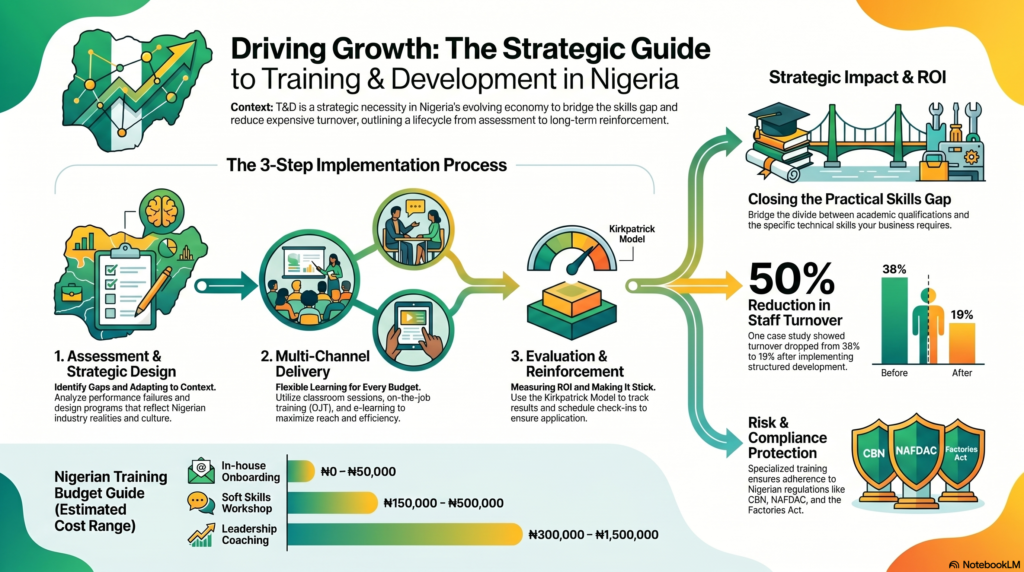
The most widely used framework is the Kirkpatrick Model, which evaluates training at four levels:
| Level | Question to Answer |
|---|---|
| Reaction | Did employees enjoy and engage with the training? |
| Learning | Did they actually learn something new? |
| Behaviour | Are they applying what they learned on the job? |
| Results | Did business outcomes improve? |
For example, if you trained your sales team in Ibadan on closing techniques, you should measure whether sales conversion rates improved in the 60–90 days after training. If they did not, something in your design or delivery needs to change.
5. Follow-Up and Reinforcement. Make It Stick
Learning fades quickly without reinforcement. After training, your HR team should:
- Schedule check-ins to see if employees are applying new skills
- Provide refresher sessions for complex topics
- Update line managers on what their team members learned so they can support application
- Incorporate new skills into performance reviews
This step is what separates Nigerian businesses that see real results from those that waste money on training that is forgotten within three weeks.
Types of Training and Development in HRM
There are several types of training and development that your HR department can deploy. Here are the most common ones, with Nigerian business examples for each.
Onboarding and Induction Training This is the first training every new employee receives. It covers company policies, culture, their role, and how things work. A fintech startup in Lagos that skips proper onboarding often finds new employees confused, disengaged, and gone within three months.
Technical or Skills Training Focused on the hard skills needed for a specific role. A manufacturing company in Aba training operators on new machinery. An accounting firm training staff on new tax filing software after a regulatory change.
Soft Skills Training Covers communication, emotional intelligence, teamwork, time management, and customer service. Often overlooked in Nigeria, but critical for customer-facing roles and management positions.
Leadership and Management Development Prepares high-potential employees and existing managers for greater responsibility. This is a core part of succession planning ensuring your business has capable leaders ready when senior staff exit.
Compliance Training Ensures employees understand and follow relevant laws and regulations critical in industries like banking, healthcare, oil and gas, and telecoms operating under Nigerian regulatory frameworks such as the CBN, NAFDAC, NUPRC, or NCC.
Safety and Health Training Essential for industries with physical risks construction, manufacturing, logistics. Prevents workplace accidents, reduces liability, and keeps your business compliant with Nigeria’s Factories Act and other safety regulations.
Diversity and Inclusion Training Helps teams across Nigeria’s multi-ethnic workforce understand each other, work better together, and create a respectful workplace culture.
Also read: Executive Leadership Training in Nigeria.
The Role of HR in Training and Development
Human resource managers do not just organise training events. Their role in training and development is strategic. Here is what a well-functioning HR team does:
- Aligns training with business goals. Every training programme should connect to what the business is trying to achieve more revenue, fewer errors, better customer satisfaction, or entry into a new market.
- Manages the training budget. HR must balance cost with impact. In Nigeria, where budgets are tight, this means prioritising high-impact training and finding cost-effective delivery methods.
- Builds a learning culture. Beyond individual programmes, HR creates an environment where continuous learning is normal and encouraged. This is how companies like Zenith Bank, Dangote Group, and MTN Nigeria build and retain strong talent.
- Tracks performance data. HR uses performance reviews, skills assessments, and key performance indicators (KPIs) to identify training needs and measure results.
- Partners with line managers. Training does not happen in a vacuum. HR must work with department heads to ensure training is relevant and that managers support employees in applying new skills.
A Real Nigerian Business Scenario: From Chaos to Clarity
The Company: A mid-sized retail chain with 12 outlets across Lagos and Ogun State, employing about 200 staff.
The Problem: Customer complaints were rising. Staff were rude, disorganised, and untrained. Store managers were inconsistent in how they ran their teams. The HR manager had no formal training programme new staff were just “shown around” by whoever was free.
What Changed: The company engaged an HR consulting firm to audit their people processes. The audit revealed three key gaps: no onboarding training, no customer service standard, and no leadership development for store managers.
The Solution:
- A 5-day onboarding programme was created for all new hires covering company values, customer service standards, and store operations
- A monthly customer service refresher was introduced for all floor staff
- Store managers were enrolled in a 3-month leadership coaching programme
- A performance management system was set up to track store-level KPIs monthly
The Results (12 months later):
- Customer complaints dropped by 43%
- Staff turnover reduced from 38% to 19% annually
- Three store managers were promoted to regional supervisor roles from within
- Average basket size per customer increased as better-trained staff became better at upselling
This is what happens when a Nigerian business takes training and development in HRM seriously.
Benefits of Training and Development in HRM for Nigerian Organisations
Let us look at the tangible benefits that well-designed training and development delivers.
Higher Employee Performance Trained employees make fewer mistakes, work faster, and produce better results. Simple as that.
Reduced Employee Turnover When employees feel that the company is investing in their growth, they are more likely to stay. This saves your business significant recruitment and onboarding costs.
Stronger Internal Talent Pipeline Development programmes prepare your best people for leadership roles. Instead of always hiring from outside which is expensive and risky you grow your own future managers.
Better Compliance and Risk Management In Nigeria’s increasingly regulated business environment, compliance training protects your business from fines, legal action, and reputational damage.
Improved Customer Experience Customers in Nigeria whether in retail, banking, hospitality, or telecoms can tell the difference between a trained staff member and an untrained one. Training shows up in how your people speak, behave, and solve problems.
Competitive Advantage Companies that build learning cultures attract better talent, retain them longer, and outperform those that do not. In Nigeria’s competitive market, this advantage is real and measurable.
Common Mistakes Nigerian Businesses Make in Training and Development
Avoid these costly errors.
Mistake 1: Training without a needs assessment Buying a generic training package and deploying it across your organisation without knowing what your people actually need is a waste of money. Always start with a proper needs assessment.
Mistake 2: Treating training as a one-off event A two-day workshop is not a training programme. Real skill development requires repetition, reinforcement, and follow-up. Build continuity into every programme you run.
Mistake 3: No budget allocation for L&D Many Nigerian SMEs treat training as optional. It is not. Even a modest, consistent training budget say ₦500,000 per quarter for a 50-person team can produce outsized results when spent wisely.
Mistake 4: Ignoring development for junior staff Too many companies only invest in senior managers. But your best future leaders are sitting in junior roles right now. Find them early. Develop them intentionally.
Mistake 5: No measurement or evaluation If you are not measuring the impact of training, you do not know if it is working. Set KPIs before you train. Review them after.
Mistake 6: HR working in isolation Training only sticks when line managers are involved. If a department head does not know what their team was trained on or does not reinforce it the investment is wasted.
How Much Does Training and Development Cost in Nigeria?
This is one of the most common questions business owners ask. The honest answer: it depends on your company size, the type of training, and the delivery method.
Here is a rough guide for Nigerian businesses:
| Training Type | Estimated Cost Range |
|---|---|
| In-house onboarding (internal facilitator) | ₦0 – ₦50,000 per cohort |
| External soft skills workshop (per day) | ₦150,000 – ₦500,000 |
| Online learning platform subscription | ₦200,000 – ₦1,000,000 per year |
| Leadership coaching programme (per person) | ₦300,000 – ₦1,500,000 |
| Full HR training audit and programme design | ₦500,000 – ₦3,000,000 (depending on scope) |
The real question is not “how much does it cost?” but “how much is it costing you NOT to train your people?” Factor in the cost of turnover, compliance violations, poor customer service, and lost productivity and training starts to look very affordable.
Learn more about our human resource services in Lagos, Nigeria from staff training and development programme design to HR audits and compliance support.
Frequently Asked Questions About Training and Development in HRM
What is training and development in human resource management?
Training and development in HRM is the structured process through which organisations improve the knowledge, skills, and abilities of their employees. Training focuses on immediate job performance. Development focuses on long-term career and leadership growth. Together, they are one of the most important strategic functions of any HR department.
What are the types of training and development in HRM?
The main types include onboarding training, technical skills training, soft skills training, leadership and management development, compliance training, safety training, and diversity training. The right mix depends on your industry, company size, and the specific gaps you are trying to close.
Why is training and development important in an organisation?
Because people are your biggest competitive asset. Training improves performance, reduces costly mistakes, increases employee retention, builds internal leadership pipelines, and ensures compliance with relevant laws and regulations. In Nigeria’s fast-moving business environment, it is essential for survival and growth.
How does training and development work in Nigerian companies?
In Nigeria, training and development can take many forms from in-house workshops and on-the-job coaching to external programmes and online learning. The most effective approach is a structured one: start with a needs assessment, design a programme aligned with business goals, deliver it consistently, evaluate results, and follow up to reinforce learning.
What is the role of HR in training and development?
HR is responsible for identifying training needs, designing and sourcing programmes, managing budgets, measuring impact, and building a culture of continuous learning. In strategic organisations, HR works closely with senior leadership to align learning programmes with the company’s long-term goals.
How much does training and development cost for small businesses in Nigeria?
Costs vary widely. Simple in-house training programmes can be built for under ₦100,000. More comprehensive programmes involving external facilitators or ongoing coaching can cost between ₦500,000 and several million naira depending on the scope. Many small businesses in Nigeria start with low-cost options internal mentoring, online courses, and peer learning and scale up as they grow.
What is the difference between training and development in HRM?
Training is short-term and task-specific it focuses on what an employee needs to do their current job better. Development is long-term and career-focused it prepares an employee for greater responsibility in the future. Both are necessary. A complete HR strategy includes both.
Conclusion: Your People Are Your Greatest Asset
Here is the truth that every successful Nigerian CEO, HR director, and business owner understands: you cannot build a great company with untrained, underdeveloped people.
Training and development in human resource management is not a box to tick. It is a strategic investment that pays dividends in performance, loyalty, customer satisfaction, and competitive advantage.
Your competitors are training their people. The best talent in Nigeria is choosing employers who invest in their growth. The question is not whether you can afford to prioritise training and development. The question is whether you can afford not to.
Start with a clear needs assessment. Design a programme that fits your team and your budget. Be consistent. Measure what you are doing. And work with HR professionals who understand the Nigerian business landscape.
The companies that win the next decade in Nigeria will be the ones with the best people and the best people come from organisations that take their growth seriously.
Ready to Build a World-Class Team in Nigeria?
Our team specialises in HR consulting, staff training and development programme design, recruitment, payroll management, and HR compliance support for businesses across Nigeria.
Whether you are a growing SME in Lagos, an established company in Abuja, or scaling operations across multiple states, we can help you build the HR systems and people development strategies that will take your business to the next level.
Contact us today to get started and let us help you build the workforce your business deserves.