
Table of Contents
You got the call. The interview is booked. Now comes the part that makes most people nervous what will they ask, and what will you say?
Here is the truth: most interviewers in Nigeria ask the same questions. Whether you are interviewing at a bank in Lagos, an oil and gas company in Port Harcourt, a tech startup in Abuja, or an NGO in Ibadan the core questions are almost always the same. The difference between candidates who get hired and those who do not is simple: preparation.
This guide covers the 50 most common job interview questions and answers in Nigeria in 2026. It also goes deep on the one question that trips up more Nigerian candidates than any other “Tell me about yourself.”
We will give you real sample answers, Nigerian-specific examples, expert tips, and a clear framework for every question. Read this once carefully. Then read it again. By the time you walk into that room, nothing should catch you off guard.
Let us get started.
Why Preparation Matters More Than Ever for Nigerian Job Seekers
Nigeria’s job market in 2026 is competitive. Very competitive. For every good role advertised, dozens sometimes hundreds of qualified candidates apply. Companies are becoming more structured about how they interview. Many now work with HR consulting firms in Nigeria to design proper interview processes. Some have multiple interview rounds. Others use score sheets and evaluation criteria.
This means the days of winging it are over. Employers are not just looking at your CV anymore. They want to see how you think, how you speak, and how you handle pressure.
The candidates who get hired are not always the most qualified. They are the most prepared. Here are the 50 Most Common Job Interview Questions and Answers in Nigeria (2026).
How to Use This Guide
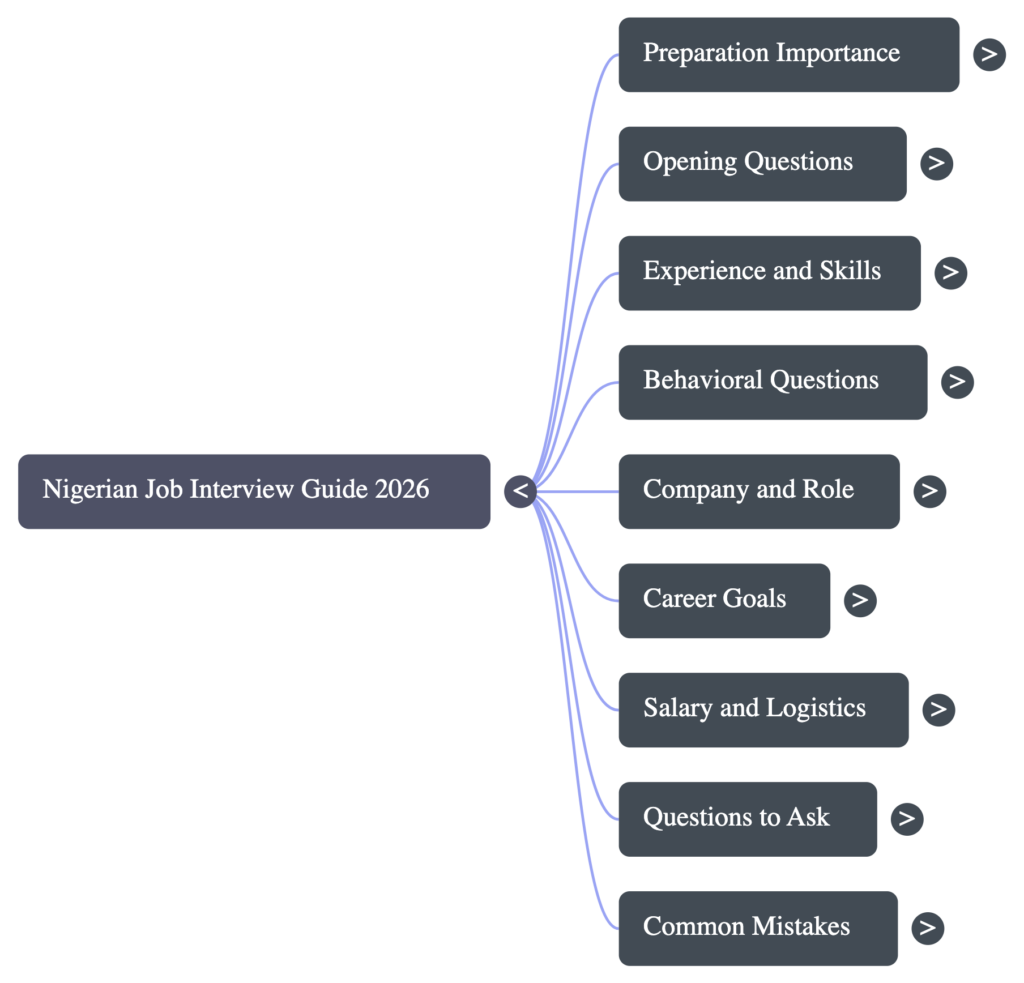
We have organised this article into categories so you can find what you need fast:
- Opening / Ice-breaker Questions (including “Tell me about yourself” the full breakdown)
- Questions About Your Experience and Skills
- Behavioral Questions (Tell me about a time when…)
- Questions About Your Strengths and Weaknesses
- Questions About the Company and Role
- Questions About Your Career Goals
- Salary and Logistics Questions
- Questions to Ask the Interviewer
Under each question, you will find:
- What the interviewer is really asking
- What to say and what NOT to say
- A sample answer with a Nigerian flavour
Also read: How to Make a Great Impression in a Job Interview.
Subscribe to get exclusive insights you won’t find anywhere else.
Opening Questions, How to Start Strong
Question 1: “Tell Me About Yourself”
This is the most important question in any job interview. It is almost always the first thing you will be asked. And yet, it is the question most Nigerian candidates answer badly.
Why? Because it sounds simple. So they do not prepare. Then they ramble, go off track, talk about their village or their church, and lose the interviewer’s attention before the real interview has even started.
What the interviewer is really asking: “Can you summarise your professional story in a way that tells me you are right for this role?”
They do not want your entire life history. They want a short, sharp, confident pitch that shows them why you are sitting in that chair.
The Formula That Works Present, Past, Future:
Use this three-part formula every time:
- Present: What you do right now (your current role or most recent experience)
- Past: How you got here (the most relevant parts of your background)
- Future: Why you are here (what you want next and why this role excites you)
Keep the whole answer under two minutes. Practice it out loud until it flows naturally.
What NOT to say:
- “My name is Adaeze and I am from Anambra State…” (Too personal, not professional)
- A full biography starting from primary school
- Anything negative about your current or past employer
- “I don’t really know where to start…” (Shows lack of preparation)
Sample Answer Entry Level (Fresh Graduate):
“I recently graduated from the University of Lagos with a degree in Business Administration, where I focused on human resource management. During my studies, I completed an internship at a Lagos-based recruitment firm, where I assisted in candidate screening and helped organise a job fair that attracted over 200 candidates. I also served as the HR lead for my department’s student union, which gave me hands-on experience in team coordination and conflict resolution. I am now looking for my first full HR role where I can grow under experienced professionals and contribute from day one. From what I have learned about your firm, this role is exactly the kind of environment where I want to build my career.”
Sample Answer. Mid-Level Professional:
“I have spent the past six years working in human resource management in the financial services sector, first at a microfinance bank in Abuja, then at a commercial bank in Lagos. In my current role as HR Officer, I manage a staff base of about 120 people handling everything from recruitment and onboarding to performance management and payroll compliance. One of my biggest achievements was redesigning our onboarding process, which cut the time it took for new staff to become fully productive from eight weeks to four. I am now at a stage where I want to take on more strategic HR responsibilities, and the Senior HR Manager role you have here is exactly the kind of next step I have been working toward.”
Subscribe to get exclusive insights you won’t find anywhere else.
Sample Answer. Senior / Management Level:
“Over the past twelve years, I have built my career in HR consulting, working with businesses across Lagos, Abuja, and Kano to solve workforce challenges from talent acquisition and labour law compliance to organisational restructuring. I have led HR projects for companies in the FMCG, oil and gas, and fintech sectors. In my most recent role as Head of HR at a mid-sized logistics company, I helped reduce staff turnover by 35% in two years and implemented a payroll compliance framework that resolved several regulatory issues with the FIRS and Ministry of Labour. I am now exploring my next move into an executive HR leadership role, and your organisation’s growth trajectory and commitment to building a strong people culture is exactly what drew me to this opportunity.”
Question 2: “Walk Me Through Your CV / Resume”
This is similar to “Tell me about yourself” but more structured. The interviewer wants you to take them through your career history job by job and explain the thread that connects everything.
What to do:
- Go in chronological order (earliest to most recent)
- Briefly explain each role and your key achievement in it
- Connect each move to the next with a “reason” why you moved, what you were going for
- End by bringing them to the present and explaining why you are here
Sample Answer (Abridged):
“I started my career in 2016 at a recruitment agency in Lagos, where I learned the fundamentals of talent sourcing and candidate assessment. After two years, I moved to an in-house HR role at a fintech startup, where I got broader exposure handling not just recruitment but also staff welfare, payroll, and compliance. That experience taught me how important it is to have proper HR systems in place as a company grows. From there, I joined my current company as an HR Generalist and have been leading all people-related functions for the past four years. Each move has been deliberate. I have always been looking for more responsibility and broader scope. This role with your firm is the next step in that direction.”
Question 3: “How Did You Hear About This Position?”
Simple question. Do not overthink it. Just be honest and if you can show that you were specifically drawn to this company, not just desperately applying everywhere.
Sample Answer:
“I came across the role on LinkedIn. But I had already been following your company for a few months I read an article about your recent expansion into the FCT market and had been impressed by how quickly you have been growing. When I saw the opening, it felt like the right time to apply.”
Questions About Your Experience and Skills
Question 4: “Why Should We Hire You?”
This is the interviewer giving you an open invitation to sell yourself. Do not waste it with a vague or humble answer.
What to say: Connect your specific skills and experience to their specific problem. Show them you have done your research and understand what they need.
Sample Answer:
“Based on what you have described today, you need someone who can come in quickly, understand your current HR structure, and help build the systems you do not yet have in place. That is exactly what I have been doing for the past five years. At my last company, we were in a similar position growing fast but without proper HR infrastructure. I built the entire process from scratch from recruitment templates to performance review systems to a payroll compliance framework aligned with Nigerian labour law. I can do the same here, and I can start contributing from week one.”
Question 5: “What Can You Bring to This Company?”
Sample Answer:
“I bring three things that I think are directly relevant here. First, practical experience in HR management within Nigerian businesses I understand the regulatory environment, the labour laws, and how FIRS and the Ministry of Labour interact with employer obligations. Second, I bring a systems-thinking approach. I do not just solve the immediate problem. I build processes so the problem does not come back. Third, I bring strong relationships. I have built trusted networks with recruitment professionals, labour law consultants, and industry peers across Lagos and Abuja that I can leverage for the benefit of your team.”
Question 6: “How Is Your Previous Experience Relevant to This Role?”
Sample Answer:
“In my previous role as an HR Officer at a construction company in Abuja, I handled everything from recruitment to contract management to staff relations. Construction is a sector where labour disputes are common and labour law Nigeria compliance is critical. Managing those challenges gave me a deep understanding of employee rights, disciplinary procedures, and how to handle grievances professionally. Those skills translate directly to this role, which also requires strong knowledge of employment law and experience managing a diverse workforce.”
Question 7: “What Are Your Greatest Strengths?”
Do not just say “I am hardworking” or “I am a team player.” Every candidate says that. Give a specific strength with a specific example to prove it.
Sample Answer:
“My greatest strength is my ability to simplify complex processes. HR in Nigeria can get complicated quickly between payroll compliance requirements, PENCOM contributions, ITF levies, and NSITF obligations, there is a lot to manage. I have a gift for taking all of that complexity and creating clear, simple systems that people can follow without confusion. At my last company, I created a compliance calendar that tracked every single HR-related statutory obligation with deadlines, responsible persons, and penalty clauses. It saved the company from two potential regulatory fines in its first year.”
Question 8: “What Are Your Weaknesses?”
Be honest. Pick a real weakness. But always show what you are doing to improve it.
What NOT to say: “I work too hard” or “I am a perfectionist.” Interviewers have heard these a thousand times and they know you are dodging the question.
Sample Answer:
“I have historically found it difficult to delegate. I like to be involved in the details and sometimes I would do a task myself rather than hand it to someone else, because I wanted it done a certain way. I recognised this was slowing my team down, so I started working on it actively I began assigning more tasks to junior team members with clear briefs, and then making myself step back and let them deliver. It has been an adjustment, but my team has grown significantly because of it, and I have been able to focus on more strategic work.”
Question 9: “Describe Your Work Ethic”
Sample Answer:
“I would describe my work ethic as disciplined and ownership-driven. When I take on a task, I see it through regardless of setbacks. At my previous job during the EndSARS disruptions in 2020, our office was temporarily closed and the whole team was working remotely with no proper systems in place. I took the initiative to set up a temporary HR helpdesk on WhatsApp for staff questions, created a remote work policy within 72 hours, and ensured payroll ran without a single day’s delay that month. I take pride in not letting circumstances become excuses.”
Question 10: “How Do You Stay Organised?”
Sample Answer:
“I use a combination of digital tools and daily planning. I start every Monday morning with a 15-minute review of the week I map out my priorities, flag any compliance deadlines for the week, and identify where I might need to pull in other people. I use Trello for project tracking and Google Calendar for all meetings and deadline reminders. For HR-specific compliance items like NSITF filings or pension remittances I have a master compliance calendar with automated reminders two weeks before each deadline. This means nothing falls through the cracks.”
Question 11: “How Do You Handle Pressure and Stress?”
Sample Answer:
“I handle pressure by staying focused on what I can control and communicating clearly with my team. When things get hectic for example, during the recruitment of 40 staff members ahead of a branch opening in Kano I break the work into smaller milestones, assign clear ownership for each part, and hold brief daily check-ins to make sure nothing is delayed. I also make sure I am honest with my manager about what is realistic. Pressure I can handle. Surprises are what I try to eliminate through good planning.”
Subscribe to get exclusive insights you won’t find anywhere else.
Question 12: “How Do You Prioritise Your Work?”
Sample Answer:
“I use an urgent-versus-important framework. Every morning, I categorise my tasks into four boxes: urgent and important do immediately; important but not urgent schedule it; urgent but not important delegate it; and neither drop it or defer it. This keeps me from spending the whole day putting out fires while strategic work gets ignored. I also communicate my priorities to my manager at the start of each week so we are always aligned.”
Behavioral Questions “Tell Me About a Time When…”
These are the questions that test your actual experience. Interviewers use them because past behaviour is the best predictor of future behaviour. Always use the STAR Method:
- S — Situation (Set the scene)
- T — Task (What was your role?)
- A — Action (What did you do specifically?)
- R — Result (What happened as a result?)
Question 13: “Tell Me About a Challenge You Faced at Work and How You Handled It”
Sample Answer:
“In my second year as an HR Officer, we discovered that a significant portion of our staff had not been enrolled on the pension scheme despite contributions being deducted from their salaries for months. This was a serious compliance failure. My task was to fix it quietly, quickly, and correctly. I reached out to our PFA, gathered the list of affected employees, and worked with finance to reconcile all outstanding remittances. I also implemented a monthly pension reconciliation checklist going forward so it could never happen again. We corrected the error before any regulatory body became involved, and all affected staff were fully enrolled within three weeks.”
Question 14: “Tell Me About a Time You Demonstrated Leadership”
Sample Answer:
“During a company restructuring exercise, the management team needed to communicate role changes to over 60 staff members. The HR Manager was away on leave and I was asked to lead the process. I organised individual briefing sessions for each affected employee, worked with legal to ensure all letters were compliant with Nigerian labour law, and set up a grievance channel for staff who had concerns. No one was left without an explanation. The process went smoothly, with zero formal complaints filed. Several senior managers later told me it was the most professionally handled restructuring they had witnessed.”
Question 15: “Tell Me About a Time You Made a Mistake”
Sample Answer:
“Early in my HR career, I processed a batch of staff contracts with an error in the leave entitlement clause — it stated 10 days annual leave instead of 15, which is the minimum under the Nigerian Labour Act. I only discovered it a month later when a staff member raised a complaint. I took full ownership, went to my manager immediately, and arranged for corrected contracts to be re-issued to all affected employees with an apology note. I then created a contract review checklist that required a second pair of eyes on all employment documents before they were sent out. That checklist is still in use at that company today.”
Question 16: “Tell Me About a Time You Disagreed With a Decision at Work”
Sample Answer:
“My manager once proposed skipping the probationary review for a new hire because the person was ‘clearly doing well.’ I disagreed not because I had concerns about the employee, but because skipping the formal review creates a precedent and removes an important checkpoint that protects both the company and the employee. I raised my concern privately, explained the labour law implications, and suggested a lighter version of the review if time was the issue. My manager agreed to a simplified review. It took 30 minutes and gave us proper documentation. I believe in following the right process, even when shortcuts are tempting.”
Question 17: “Tell Me About a Time You Failed”
Sample Answer:
“I once underestimated how long it would take to fill a specialised role an industrial safety officer for a manufacturing plant in Ogun State. I told management we would have the right candidate in three weeks. Six weeks later, we were still searching. I had not accounted for how narrow the talent pool was for that combination of qualifications and experience. The delay affected a production deadline. I learned from that experience to always research the talent market before giving a hiring timeline, and to build in a buffer when filling technical or specialised roles.”
Question 18: “Tell Me About a Time You Worked Under Pressure”
Sample Answer:
“During the COVID-19 lockdowns in 2020, our company had to transition 200 employees to remote work in less than 72 hours. I was part of the two-person HR team responsible for making it happen. We had no remote work policy, no systems for tracking attendance, and no plan for how to handle staff who did not have laptops at home. I worked through the night with our IT team, drafted an emergency remote work policy, created a daily check-in system via Google Forms, and arranged for ten critical staff members to receive data allowances to stay connected. Every department was operational by Monday morning. That experience taught me what I am capable of under genuine pressure.”
Questions About the Company and Role
Question 19: “Why Do You Want to Work at This Company?”
Never give a generic answer. Always be specific. Show them you did your research.
Sample Answer:
“I have been following your company’s growth for about two years. What specifically drew me here is the fact that you are one of the few HR consulting firms in Nigeria that has invested seriously in technology-driven HR solutions. I read about your new HRIS implementation project and that is exactly the kind of work I want to be part of. I also spoke with two people who have worked here before, and both described a culture of learning and professional development. That is the kind of environment where I do my best work.”
Question 20: “Why Do You Want This Specific Job?”
Sample Answer:
“This role combines the two areas I am most passionate about HR strategy and people development. The fact that it covers both the operational HR side and the learning and development function is rare to find in one role. It also gives me exposure to senior leadership, which is important at this stage of my career. I want to understand how HR decisions connect to business strategy, and this role sits right at that intersection.”
Question 21: “What Do You Know About Our Company?”
Sample Answer:
“I know that you were founded in Lagos in 2010 and have since expanded to Abuja and Port Harcourt. You specialise in HR outsourcing, payroll management, and recruitment services for mid-to-large Nigerian businesses. I also read that you recently partnered with a global HR technology firm to enhance your HRIS offering. What caught my attention most is that you have a strong reputation for labour law compliance advisory, which is an area I have been developing my expertise in. I am genuinely excited about what you are building.”
Subscribe to get exclusive insights you won’t find anywhere else.
Question 22: “What Interests You About This Role?”
Sample Answer:
“Three things stand out. First, the scope this is not a narrow, administrative HR role. It requires strategic thinking and business partnership, which is where I want to grow. Second, the industry exposure working with multiple client companies means I will encounter a wide range of HR challenges, which will sharpen my skills far faster than a single-company role would. Third, the team based on my research, your HR team has some of the most experienced practitioners in the country and I believe I will learn enormously from working alongside them.”
Also read: Best Corporate Leadership Training Companies in Lagos.
Questions About Career Goals
Question 23: “Where Do You See Yourself in Five Years?”
Be realistic and be specific. Do not say “I want to be CEO.” Connect your five-year vision to the trajectory this role offers.
Sample Answer:
“In five years, I see myself in a senior HR leadership role either as Head of HR or HR Director in a mid-to-large organisation. I want to be the person who is shaping people strategy at the executive level, not just executing HR tasks. This role is a deliberate step toward that. It will give me exposure to business partnering, HR technology, and multi-sector experience, which are exactly the gaps I need to fill to be ready for that next level.”
Question 24: “What Are Your Career Goals?”
Sample Answer:
“My immediate goal is to deepen my expertise in HR strategy and human resource management in Nigeria specifically in areas like workforce planning and talent development. My longer-term goal is to eventually lead the HR function of a growing Nigerian business, where I can directly influence company culture and staff performance. I am also working toward my CIPM certification, which I expect to complete later this year.”
Question 25: “What Motivates You?”
Sample Answer:
“I am most motivated by impact. When I can see that my work has made a real difference whether that is helping someone land a job that changes their life, or helping a company fix a payroll problem that was affecting staff morale that is what drives me. I also find real energy in solving problems that other people have given up on. The more complex the HR challenge, the more engaged I become.”
Salary and Logistics Questions
Question 26: “What Are Your Salary Expectations?”
Do your research first. Know the market rate for the role in your city and industry before you go into any interview.
Sample Answer:
“Based on my research and my level of experience, I am looking for something in the range of ₦350,000 to ₦420,000 monthly, all-in. However, I am also very interested in the full compensation package including health insurance, pension, and growth opportunities and I am open to a conversation if the total package makes sense.”
Question 27: “Why Are You Leaving Your Current Job?”
Always stay positive. Never speak badly about your current employer. Focus on what you are moving toward, not what you are running from.
Sample Answer:
“I have genuinely enjoyed my time at my current company and learned a great deal. But I have reached a ceiling in terms of what I can learn and the level of responsibility available to me. I am ready for a more strategic role with greater scope, and the opportunity here offers exactly that. It is not about leaving it is about growing.”
Question 28: “When Can You Start?”
Sample Answer:
“I will need to give my current employer one month’s notice, which is standard under my contract. So I can start one month from the date of a formal offer. If there is urgency, I am willing to speak with my employer about an earlier release.”
Question 29: “Are You Currently Interviewing With Other Companies?”
Be honest, but do not give leverage away.
Sample Answer:
“I am in conversations with one other company, yes. But I want to be clear this role is my first choice. The scope of the work and the reputation of your firm made this the application I was most excited about. I am hopeful we can reach an agreement.”
Question 30: “Do You Have Any Questions for Us?”
Never say “No, I think I am fine.” Always have questions. It shows you are serious and genuinely interested.
Sample Questions to Ask:
- “What does success look like in this role in the first 90 days?”
- “What is the biggest challenge the HR team is currently facing?”
- “How would you describe the company culture here?”
- “What are the opportunities for growth and professional development in this role?”
- “Can you tell me about the team I would be working with directly?”
More Common Questions Quick Reference (Questions 31–50)
Here is a quick-reference guide for more questions you may face:
| # | Question | Key Point to Make |
|---|---|---|
| 31 | How would your colleagues describe you? | Pick one trait and back it with a real example |
| 32 | How do you define success? | Connect it to impact, not just personal achievement |
| 33 | Do you consider yourself successful? | Say yes and give one specific example |
| 34 | What makes you unique? | Identify one differentiator that is directly relevant to the role |
| 35 | What is your greatest professional achievement? | Use STAR format — include numbers if possible |
| 36 | How do you work under a difficult manager? | Stay positive, focus on communication and professionalism |
| 37 | What is your work style? | Match it as closely as possible to what the company values |
| 38 | What type of work environment do you prefer? | Research the company culture and align your answer |
| 39 | Tell me about a time you showed initiative | Specific story what you noticed, what you did, what happened |
| 40 | What are you passionate about? | Be genuine. Connect it to the role if you can |
| 41 | How do you handle conflict with a coworker? | Stay professional. Focus on resolution, not blame |
| 42 | Can you work under pressure? | Say yes and give a real Nigerian workplace example |
| 43 | What do you like least about your current job? | Keep it positive. Frame it as what you are looking for next |
| 44 | What are you looking for in this role? | Skills growth + impact + alignment with career goals |
| 45 | What is your management style? | Flexible and results-focused, with a real example |
| 46 | Describe your ideal company culture | Collaborative, structured, growth-focused research the company first |
| 47 | How do you keep up with industry trends? | Name specific sources CIPM, LinkedIn, industry publications |
| 48 | Are you a team player or do you prefer working alone? | Both, give a real example for each context |
| 49 | Tell me about a time you trained or mentored someone | Use STAR, include what the person achieved because of you |
| 50 | What would you do in your first 30-60-90 days here? | Research, listen, build relationships, identify quick wins |
A Real Nigerian Scenario: Preparation That Won the Job
The situation: Emeka is 29. He is applying for an HR Generalist role at a fast-growing fintech company in Lagos. He has three years of HR experience at a commercial bank but has never worked in tech. He is nervous about the industry gap.
What he did: Emeka spent two evenings preparing. He rehearsed his “Tell me about yourself” answer using the Present-Past-Future formula. He researched the fintech company and found they had recently tripled their staff from 50 to 150 in 12 months. He tailored his preparation to this: he prepared stories about managing rapid onboarding, handling high recruitment volumes, and building HR processes from scratch all of which he had done at the bank.
When the interviewer asked “Tell me about yourself,” Emeka gave a clean, two-minute answer that ended with: “Your company has grown from 50 to 150 people in a year, and from what I have read, you are planning to double again in 2026. That kind of growth is exactly what I have been managing at my current company, and it is the reason I applied specifically here.”
He got the offer within five days.
The lesson: Preparation is not about memorising perfect answers. It is about understanding what the company needs and showing them, clearly and confidently, that you can deliver it.
Common Mistakes Nigerian Job Seekers Make in Interviews
1. Talking too long. Especially on “Tell me about yourself.” Two minutes. No more.
2. Not researching the company. If you cannot say two or three specific things about the company, you look like you are applying everywhere blindly.
3. Speaking badly about former employers. It always backfires. No matter what happened, keep it professional.
4. Using vague answers. “I am a team player” means nothing without an example. Always back up your claims with a story.
5. Not preparing questions to ask. Saying “No, I think I am fine” at the end of an interview tells the interviewer you are not genuinely curious about the role or company.
6. Ignoring salary research. Walking into a salary negotiation without knowing the market rate is like going to Balogun Market without knowing the price of what you want to buy.
FAQ: Common Job Interview Questions and Answers in Nigeria
What is the most common interview question in Nigeria?
Tell me about yourself” is asked in almost every interview in Nigeria. It is usually the very first question. Prepare a clear, confident two-minute answer using the Present-Past-Future formula.
How should I answer “Tell me about yourself” in a Nigerian job interview?
Start with your current or most recent role. Then briefly describe your background and how you got there. End by explaining what you are looking for next and why this specific role excites you. Keep it under two minutes and make it work-focused, not personal.
How do HR consulting firms in Nigeria help with interview preparation?
HR consulting firms in Nigeria help both candidates and employers. For job seekers, they provide career coaching, CV reviews, mock interview sessions, and market intelligence on salary expectations. For employers, they design structured interview processes and train hiring managers on fair and effective evaluation methods.
What are behavioral interview questions and how do I answer them in Nigeria?
Behavioral questions start with “Tell me about a time when…” They are used by Nigerian employers to assess how you have handled real situations in the past. Always use the STAR method Situation, Task, Action, Result to give a structured, specific answer.
How important is salary negotiation in Nigerian job interviews?
Very important. Research the market rate before any interview. Know your minimum acceptable salary and your ideal salary. Be ready to give a range when asked, and always frame your ask in the context of your experience and value not just your personal financial needs.
What do Nigerian employers look for most in a job interview?
Most Nigerian employers especially those that work with HR consulting professionals look for four things: communication skills, relevant experience, cultural fit, and evidence of problem-solving. The candidates who demonstrate all four, with real examples, are the ones who get hired.
Conclusion: Preparation Is the Interview
Here is the one thing that ties every question in this guide together: none of these questions should surprise you on the day. Every single one can be prepared for. Every single one has a formula.
The “Tell me about yourself” question is the most important one you will ever answer in a job interview in Nigeria. If you nail that in the first two minutes, you set the tone for everything that follows. Use the Present-Past-Future formula. Practice it out loud. Make it specific to the role.
Then work through the rest of the questions in this guide. Build real stories from your own career using the STAR method. Research every company before you walk in. Prepare smart questions to ask.
The candidates who get hired in Nigeria’s competitive job market in 2026 are not always the most qualified. They are the most prepared, the most confident, and the most specific in how they present their value.
That can be you.
Work With Nigeria’s HR Experts, For Hiring and Career Growth
Whether you are a professional preparing for your next big interview or a business owner looking to build a stronger, more structured hiring process, we are here to help.
Our team provides HR consulting, recruitment, HR outsourcing, payroll compliance, and labour law advisory for businesses across Nigeria. We help companies find the right people and help professionals present their best selves to the market.
Contact us today to get started. Let us take the stress out of hiring and career growth.
Learn more about our human resource management services in Nigeria and how we support both employers and job seekers across Lagos, Abuja, and beyond.
Looking for your next role? See current vacancies or submit your CV.
Hiring for your organisation? Fill in the short form below and our team will get back to you.
References
- The Muse — 60+ Most Common Interview Questions and Answers
- Career Sidekick — Top 40 Essential Interview Questions and Answers
- Indeed — Top 20 Interview Questions With Sample Answers
- MyJobMag Nigeria — Top 100 Job Interview Questions and Answers
- Chartered Institute of Personnel Management of Nigeria (CIPM) — Professional HR Standards