
Table of Contents
When you walk into a job interview whether in Lagos, Abuja, Port Harcourt, or anywhere else in Nigeria, you have a limited window to show an employer that you are the right person for the job. Learning how to make a great impression in a job interview is not just about dressing well or memorizing answers. It is about showing up prepared, confident, and human.
And in 2026, the rules have shifted slightly. Companies in Nigeria are becoming more structured in how they hire. More businesses are working with HR consulting firms in Nigeria to design professional interview processes. Employers now look beyond your CV. They want to see your mindset, your communication style, and how you carry yourself under pressure.
This guide will walk you through everything, before, during, and after the interview. Whether you are a fresh graduate in Enugu or a seasoned professional in Victoria Island, this article is for you.
Let us get into it.
What “Making a Great Impression” Actually Means
Before we dive into the tips, let us break this down simply.
Making a great impression does not mean pretending to be someone you are not. It does not mean memorizing a script or wearing an expensive suit you feel uncomfortable in.
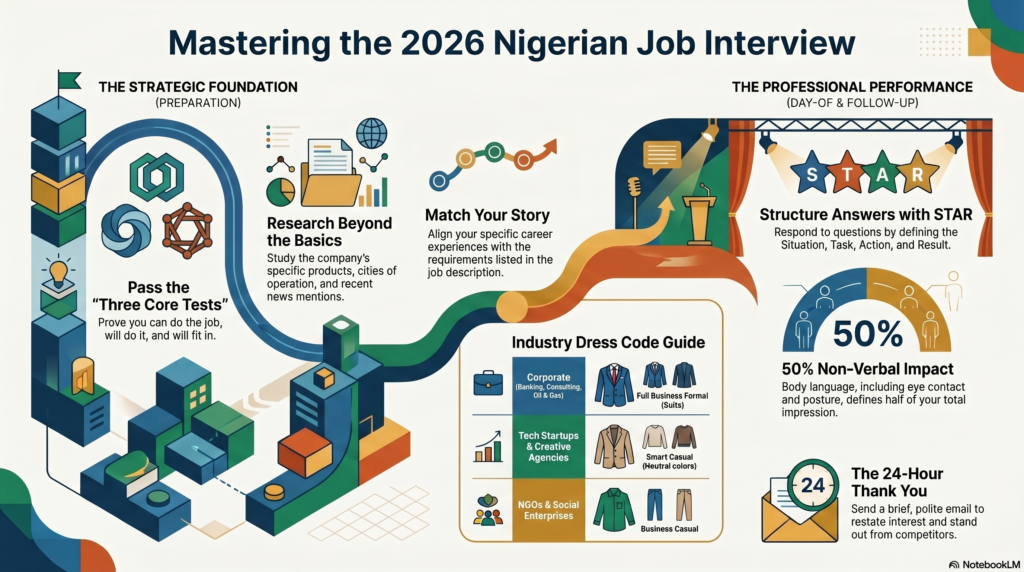
It means showing the interviewer three things:
- You can do the job. You have the skills and experience.
- You will do the job. You are motivated and serious.
- You will fit in. You match the company’s values and culture.
That is all an interview is really testing. Everything we cover in this article ties back to those three things.
In Nigeria, where competition for good jobs is high, knowing how to communicate these three things clearly, in a confident and authentic way, is what separates the candidates who get hired from those who keep trying.
Why Job Interview Skills Matter More Than Ever in Nigeria
Nigeria’s job market in 2026 is both exciting and demanding. On one hand, new industries are growing — tech, fintech, digital marketing, renewable energy, and professional services. On the other hand, there are more qualified candidates competing for fewer roles.
Companies that use structured hiring processes, often supported by HR outsourcing firms in Nigeria or internal HR teams, are now more systematic about how they evaluate candidates. A poorly handled interview can cost you a great opportunity, even if your CV is impressive.
Here is something many Nigerian job seekers do not realize: hiring managers often make up their minds about a candidate within the first few minutes of the interview. First impressions are that powerful. That is why preparation is not optional — it is survival.
Before the Interview: Preparation Is Your Secret Weapon
Research the Company Properly
This is the step most candidates skip, and it is the one that makes the biggest difference.
Before your interview, find out:
- What does the company do? What is their main product or service?
- How long have they been in business?
- Who are their major clients or competitors?
- Have they been in the news recently?
- What are their values and mission?
You can find most of this information on their website, their LinkedIn page, or through a simple Google search.
Why does this matter?
Because when an interviewer asks you, “What do you know about our company?” and they will, you want to give a real, detailed answer. Not a vague one. Candidates who research the company show that they are serious. Those who do not research look careless.
For example, if you are interviewing at a Lagos-based logistics company, you should know whether they do last-mile delivery, what cities they operate in, and if they recently raised funding or launched a new service. That level of detail impresses hiring managers.
Study the Job Description Like an Exam
Every word in a job description is a clue. Read it carefully.
Make a list of the skills and qualities they are asking for. Then write down how your experience matches each one. This is called matching your story to their needs, and it is one of the most powerful things you can do before an interview.
For instance, if the job requires “strong communication skills and the ability to work with cross-functional teams,” be ready to tell a story about a time you did exactly that.
Practice Out Loud — Not Just in Your Head
Most people prepare for interviews by reading notes in their head. That does not work. You need to practice speaking.
Sit in front of a mirror. Record yourself on your phone. Ask a friend or family member to do a mock interview with you. The goal is to hear how you sound and fix the weak parts before the real thing.
Focus on these common interview questions:
- “Tell me about yourself.”
- “What are your strengths and weaknesses?”
- “Why do you want to work here?”
- “Describe a challenge you faced and how you handled it.”
- “Where do you see yourself in five years?”
None of these should catch you off guard on the day. If they do, you have not prepared enough.
Prepare Smart Questions to Ask the Interviewer
An interview is a two-way conversation. The interviewer will almost always say, “Do you have any questions for us?” And “No, I don’t think so” is one of the worst answers you can give.
Prepare two to three thoughtful questions such as:
- “What does success look like in this role in the first 90 days?”
- “What are the biggest challenges the team is currently facing?”
- “How would you describe the company culture here?”
These questions show that you are not just desperate for any job, you are evaluating whether this is the right place for you. That confidence is attractive to employers.
Also read: Top 5 HR Services for Small Businesses in Nigeria
How to Make a Great Impression in a Job Interview on the Day
Dress the Part — Every Time
In Nigeria, how you dress speaks before you open your mouth. Even if the company has a casual culture, an interview is a formal occasion. Dress one level above what the employees wear every day.
General rule:
- Corporate companies (banks, consulting firms, oil and gas): Full business formal, suit, tie for men; formal dress or suit for women.
- Tech startups or creative agencies: Smart casual, clean, well-fitted clothes in neutral or professional colours.
- NGOs or social enterprises: Smart casual to business casual.
When in doubt, overdress. No one has ever lost a job offer for looking too professional.
Arrive Early — Not on Time
“On time” in a job interview means five to ten minutes early. Not at the exact time. Not one minute late.
If the interview is at 10am, aim to arrive by 9:45am. This gives you time to settle, breathe, and mentally prepare. Rushing in at the last minute raises your anxiety and throws off your composure.
If the interview is virtual, which is increasingly common in Nigeria, log in five minutes before the meeting starts. Test your internet connection, camera, and microphone the night before.
Your Body Language Speaks for You
When you walk into an interview room, before you say a single word, your body is already communicating.
Here is what to do:
- Stand tall and walk with confidence. Not arrogance, confidence. There is a difference.
- Give a firm handshake. Not too tight, not too weak.
- Smile genuinely. A real smile puts both you and the interviewer at ease.
- Sit up straight. Do not slouch in the chair.
- Make eye contact. When answering questions, look at the interviewer. Do not stare at the floor or the ceiling.
- Nod when they speak. It shows you are listening and engaged.
Body language is so powerful that researchers say it accounts for more than 50% of the impression you make. Master it.
Answer Questions Using the STAR Method
When an interviewer asks a behavioral question, like “Tell me about a time you handled a difficult customer” do not ramble. Use the STAR method:
- S — Situation: Briefly describe the context.
- T — Task: What was your role or responsibility?
- A — Action: What did you specifically do?
- R — Result: What happened because of your actions?
Nigerian Example: “At my previous role in a retail shop in Ikeja, we had a supplier who kept delivering wrong products (Situation). My job was to manage supplier relationships and resolve issues (Task). I called a meeting with the supplier, showed them the discrepancies in writing, and proposed a new delivery checklist (Action). After implementing the checklist, wrong deliveries dropped by 80% over the next three months (Result).”
That kind of answer is clear, structured, and memorable. It shows that you solve problems, not just that you worked somewhere.
Stay Calm When Questions Are Difficult
Every interviewer will throw a hard question at you at some point. It is deliberate. They want to see how you handle pressure.
When this happens:
- Take a breath.
- Pause for a second before answering. It shows you are thoughtful, not panicked.
- If you do not understand the question, it is perfectly fine to say, “Can you clarify what you mean by that?”
- If you do not know the answer, be honest. Say, “I don’t have direct experience with that, but here is how I would approach it…”
Composure under pressure is one of the qualities that Nigerian employers, especially those guided by professionals in human resource management in Nigeria value most.
After the Interview: Do Not Waste the Opportunity
Send a Thank-You Message
Within 24 hours of your interview, send a short, polite thank-you email to the interviewer.
Keep it simple:
- Thank them for their time.
- Mention one specific thing you discussed.
- Restate your interest in the role.
Most Nigerian candidates do not do this. That means if you do it, you automatically stand out. It is a small action with a big impact.
Reflect and Improve
After every interview, ask yourself:
- What went well?
- What questions caught me off guard?
- Did I communicate my value clearly?
- Was there anything I said that I should improve next time?
Write down your answers. This turns every interview, even a failed one, into a learning experience.
Follow Up Professionally
If you have not heard back within the timeframe they gave you, send one polite follow-up email. Keep it brief and professional.
Do not send multiple messages. Do not call repeatedly. Desperation damages impressions faster than almost anything else.
A Real Nigerian Scenario: What a Great Interview Looks Like
The Situation: Ngozi is 28 years old. She is applying for a marketing coordinator role at a growing fintech company in Victoria Island, Lagos.
Before the Interview: Ngozi spent two evenings researching the company. She read their website, followed their LinkedIn page, and noticed they recently launched a new savings product targeting young Nigerians. She prepared three questions about the product’s growth strategy.
During the Interview: She arrived ten minutes early, dressed in a neat navy suit. When asked why she wanted the role, she referenced the new product launch and explained how her digital marketing experience aligned with reaching the youth audience they were targeting. She answered every behavioral question using the STAR method, clear, specific, and confident. When asked a question she was unsure about, she paused, thought it through, and gave a structured answer instead of bluffing.
After the Interview: She sent a thank-you email that evening. Two weeks later, she was offered the role.
The lesson? Ngozi did not get the job because she was the most qualified. She got it because she prepared better than everyone else.
Benefits of Learning How to Interview Well
When you master how to make a great impression in a job interview, you gain far more than just a job offer:
- More confidence in professional settings overall
- Better career progression because you can present your value clearly
- Stronger professional reputation, interviewers remember impressive candidates, even when they do not hire them immediately
- Higher earning potential, confident, well-prepared candidates negotiate better salaries
- Less anxiety around job hunting, because you feel ready
For businesses, having employees who interview and present well also matters. Especially when HR departments, often supported by HR outsourcing companies in Nigeria, are building stronger hiring pipelines.
Common Mistakes to Avoid in a Job Interview
1. Not researching the company. Walking into an interview without knowing what the company does is an immediate red flag for any hiring manager. Always research first.
2. Arriving late. In Nigeria’s urban cities, traffic is a real challenge. Leave early. Factor in potential delays. Lateness signals disrespect, whether you intend it or not.
3. Speaking negatively about your former employer. No matter how bad your last job was, never speak badly about your former company or boss in an interview. It makes you look unprofessional and difficult. Instead, say what you are looking for in your next role.
4. Giving vague answers. Answers like “I am a hard worker” and “I am very dedicated” mean nothing without proof. Use specific examples and numbers whenever you can.
5. Forgetting to ask questions. Not asking any questions at the end of the interview sends the message that you are not genuinely interested. Always prepare questions.
6. Dressing inappropriately. In Nigerian corporate culture especially, how you dress matters enormously. Sloppy dressing is seen as a sign of how seriously you take the opportunity.
FAQ: How to Make a Great Impression in a Job Interview
Q: What is the most important thing to do before a job interview? Research the company and practice answering common interview questions out loud. These two things alone will put you ahead of most other candidates.
Q: How early should I arrive for a job interview in Nigeria? Arrive at least 10 minutes before the scheduled time. If it is your first time visiting the location, do a test run the day before so you know exactly where to go and how long it takes.
Q: What should I wear to a job interview in Nigeria? Dress professionally. For corporate roles, wear formal business attire. For startups or creative companies, smart casual is acceptable. When in doubt, dress more formally.
Q: How does HR consulting in Nigeria help with hiring and interviews? HR consulting firms in Nigeria help companies design structured interview processes, train interviewers, and create evaluation criteria. This means candidates are assessed fairly and consistently. Understanding how this works helps you prepare better for structured interviews.
Q: Is it appropriate to follow up after a job interview in Nigeria? Yes. Send a brief, polite thank-you email within 24 hours. If you have not heard back within the given timeframe, one follow-up email after five to seven business days is professional and appropriate.
Q: How does labour law in Nigeria affect the hiring process? Under labour law in Nigeria, employers must follow fair and non-discriminatory hiring practices. This means you cannot legally be rejected based on gender, religion, or ethnicity. Knowing your rights as a candidate gives you confidence in the process.
Conclusion: Preparation Is the Interview
Here is the truth about how to make a great impression in a job interview, the impression does not start in the interview room. It starts days before, when you sit down to research, practice, and prepare.
The candidates who get hired in Nigeria’s competitive job market in 2026 are not always the most qualified. They are the ones who prepare the most, show up with confidence, communicate their value clearly, and follow up professionally.
Use every tip in this guide. Research the company. Practice your answers. Dress well. Arrive early. Master your body language. Say thank you after.
Each of these actions is simple on its own. Together, they create the kind of impression that stays with an interviewer long after you leave the room, and turns a conversation into a job offer.
Work With Nigeria’s HR Experts to Hire or Get Hired Smarter
Whether you are a professional preparing for your next career move, or a business owner looking to build a stronger team, we are here to help.
Our team offers HR consulting, recruitment, talent sourcing, payroll compliance, and labour law advisory for businesses across Nigeria. We help companies find the right people and help professionals present their best selves in the market.
Contact us today to get started. Let us take the hard work out of hiring and career growth.
Learn more about our human resource management services in Nigeria and how we support both employers and job seekers.
References
- Adecco Group — How to Make a Great Impression in a Job Interview – Tips 2026 — adecco.com
- Chartered Institute of Personnel Management of Nigeria (CIPM) — Professional Standards in Nigerian HR Practice — cipmnigeria.org
- LinkedIn — Career Advice: Interview Preparation and Professional Branding — linkedin.com
- Nigerian Labour Act (Cap L1, LFN 2004) — Federal Ministry of Labour and Employment — labour.gov.ng
- World Economic Forum — The Future of Jobs Report 2025: Skills, Hiring, and Workforce Trends — weforum.org