
Table of Contents
Let’s be honest most business owners know something is off in their team before they can put a finger on what it is. What Is a Staff Audit? Everything You Needs to Know. Maybe some roles feel duplicated. Maybe you have people hired years ago whose skills no longer match what your business actually needs today. Or maybe you are paying for positions that are not really delivering results.
That feeling is your cue to run a staff audit.
A staff audit is one of the most underused tools in HR yet it can completely change how you manage people, cut costs, improve performance, and build a more effective team. In this guide, we are going to break it all down in plain English so you can walk away knowing exactly what a staff audit is, why it matters, and how to run one without the headache.
What Is a Staff Audit?
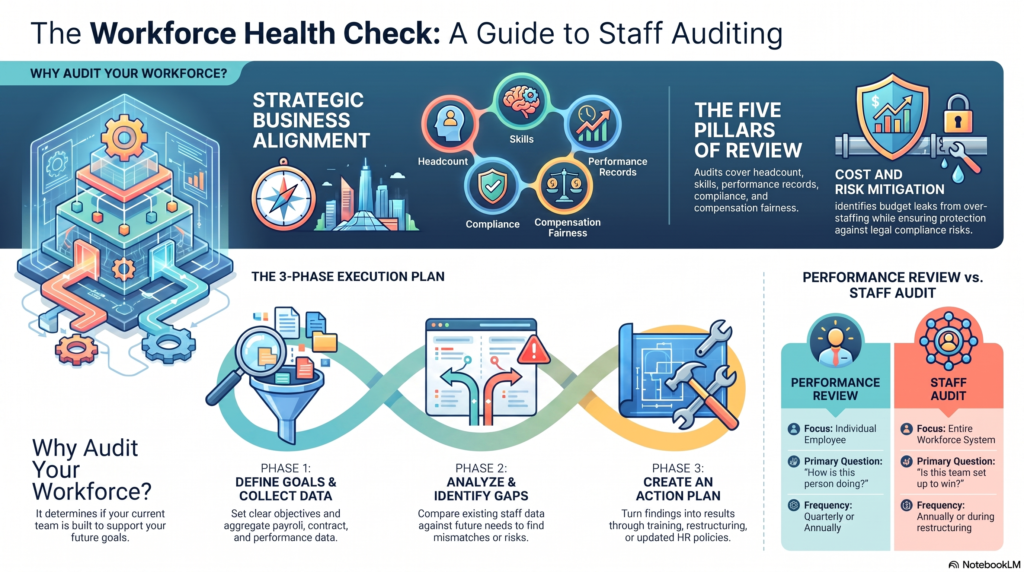
A staff audit also called a workforce audit or HR audit is a structured review of your entire workforce. It gives you a clear, accurate picture of who you have working for you, what they do, what skills they bring, how they are performing, and whether your people resources are actually aligned with your business goals.
Think of it like a health check but instead of checking your blood pressure, you are checking the health of your workforce.
Unlike a performance review (which focuses on individual employees), a staff audit looks at your whole team as a system. It asks: “Is our workforce built to support where this business is going?”
Why Does a Staff Audit Matter for Your Business?
If your business is growing, restructuring, or facing challenges, a staff audit is not optional it is essential. Here is why:
- It helps you find skill gaps before they become a crisis. You may not realise your customer service team lacks digital communication skills until your reviews start tanking online. A staff audit surfaces these gaps early.
- It saves money. Overstaffing in one department and understaffing in another is a budget leak. A staff audit shows you where to reallocate before you hire or fire unnecessarily.
- It keeps you legally compliant. From employment contracts to certifications and training records, a staff audit ensures your documentation is in order and you are not exposed to legal risk.
- It boosts productivity. When the right people are in the right roles with the right support, output improves naturally without extra cost.
- It supports better decision-making. Data-backed HR decisions always outperform gut-feel decisions. A staff audit gives you that data.
What Does a Staff Audit Cover?
A thorough staff audit typically reviews five key areas:
1. Headcount and Roles
This is the basics how many people do you employ, in what positions, under what arrangement (full-time, part-time, contract, or casual)? You want to make sure every role on your payroll has a clear purpose and is genuinely needed.
2. Skills and Competencies
What can your team actually do? This involves mapping the skills of each employee against what each role requires and identifying where there are mismatches, outdated knowledge, or missing expertise.
3. Performance Records
How have employees been performing over time? This includes reviewing past appraisals, productivity data, attendance history, and any disciplinary or commendation records.
4. Compliance and Documentation
Are employment contracts up to date? Are staff certifications current? Have mandatory trainings (health and safety, data protection, etc.) been completed and documented? This area alone can save you from costly legal trouble.
5. Compensation and Benefits
Are your employees being paid fairly and consistently relative to their roles and market rates? A staff audit helps you spot pay inequities, bloated benefits packages, or areas where compensation is out of step with the work being done.
When Should You Conduct a Staff Audit?
There is no single “perfect time” for a staff audit but there are certain moments when running one becomes especially important:
- When your business is about to scale or restructure
- After a major change in leadership or ownership
- When you notice a consistent dip in productivity or team morale
- Before hiring to ensure you are not duplicating existing roles
- During budget reviews or cost-cutting exercises
- Annually as a regular HR health check
If any of these apply to your business right now, it is a good idea to begin planning your staff audit.
Also read: The Value of Background Checks for HR Management
How to Run a Staff Audit Step-by-Step
Running a staff audit does not need to be overwhelming. Here is a simple, practical process you can follow:
Step 1: Define Your Audit Goals
Before you gather a single spreadsheet, be clear on why you are running this audit. Are you trying to reduce costs? Identify training needs? Prepare for expansion? Your goal will shape everything else.
Step 2: Collect Your Workforce Data
Pull together all the information you have about your staff from your HR software, payroll system, performance management tools, or even manual records. This includes job titles, contract types, salaries, skills, qualifications, performance ratings, and attendance data.
Step 3: Analyse and Compare
Now, review the data against your current business needs and future plans. Are roles well-defined? Are the right people in the right positions? Are some teams overstaffed while others are stretched thin?
Step 4: Identify Gaps and Risks
Look for patterns. What skills are missing across the team? Which roles are unclear or overlapping? Are there compliance risks hiding in outdated contracts or incomplete records? Document every finding big or small.
Step 5: Create an Action Plan
A staff audit without action is just a report. Based on your findings, build a clear plan this might include training programmes, restructuring of roles, hiring in specific areas, updating HR documentation, or adjusting pay scales. Set timelines, assign responsibility, and track progress.
Common Mistakes to Avoid When Running a Staff Audit
Even well-intentioned staff audits can go sideways. Watch out for these pitfalls:
- Treating it as a one-time exercise. Workforce needs change. Make the staff audit a recurring practice, not a one-off event.
- Being vague about the purpose. If employees don’t understand why the audit is happening, fear and resistance will follow. Communicate clearly and honestly.
- Relying on outdated data. An audit is only as good as the data feeding it. Ensure your records are current before you start.
- Overlooking employee input. Your staff often knows where the inefficiencies are. A well-designed survey or structured conversation can reveal insights no spreadsheet will show you.
- Skipping the action plan. The audit is the diagnosis. Without treatment an action plan the exercise is wasted effort.
Staff Audit vs. Performance Review. What Is the Difference?
People often mix these two up they are not the same thing.
A performance review is about an individual employee. It looks at how well one person is doing their job relative to set targets and expectations. It is personal, focused, and usually happens on a set schedule quarterly or annually.
A staff audit is about your entire workforce as a whole. It zooms out to see how your team is structured, whether your people resources match your business needs, and where there are systemic risks or gaps across departments, roles, and the organisation as a whole.
In short: a performance review asks “How is this person doing?” A staff audit asks “Is this team set up to win?”
Both are important and both work best when used together as part of a broader HR strategy.
Frequently Asked Questions About Staff Audits
How long does a staff audit take?
The timeline depends on the size of your organisation. A small business with fewer than 20 employees can complete a basic staff audit in one to two weeks. Larger organisations with multiple departments may need four to eight weeks. The key is not to rush it a thorough audit done slowly is far more valuable than a quick one with gaps.
Who should carry out a staff audit?
It depends on your resources. Some businesses handle it internally through their HR team. Others bring in an external HR consultant which is often the better option if you want objective, unbiased findings. An external consultant is not emotionally attached to the team, which makes it easier to spot problems and recommend honest solutions.
Is a staff audit the same as a HR audit?
Not exactly though they overlap. A staff audit focuses specifically on your workforce: who you have, what they do, and how they perform. An HR audit is broader and also reviews your HR policies, processes, systems, and compliance frameworks. Think of a staff audit as one important chapter within a full HR audit.
Do employees need to know a staff audit is happening?
Yes and transparency here is non-negotiable. Employees who find out about an audit without being informed will assume the worst. A simple, honest communication from leadership explaining the purpose of the audit goes a long way in reducing anxiety and getting employee cooperation. You will also get better data when people are not on edge.
How often should a business run a staff audit?
At minimum, once a year. Many growing businesses do a light review every six months and a full audit annually. If your business is going through a major change a merger, rapid growth, leadership transition, or economic pressure do not wait for the annual cycle. Run one as soon as the need arises.
Final Thoughts: Your Workforce Is Your Greatest Asset. Treat It That Way
A staff audit is not about finding fault with your employees. It is about being intentional with your most valuable resource your people.
When you know who you have, what they can do, and how they are performing, you make smarter decisions whether that is in hiring, training, restructuring, or planning for growth. You stop guessing and start leading with data.
The businesses that thrive are not always the ones with the most staff they are the ones with the right staff, in the right roles, doing the right things. A staff audit is how you get there.
Ready to run a staff audit but not sure where to start? Anthrop Management Limited specialises in helping businesses of all sizes assess, organise, and optimise their workforce. Reach out to us today and let’s build a stronger, smarter team together.
References
- Society for Human Resource Management (SHRM). (2023). HR Audit Checklist.
- Armstrong, M. & Taylor, S. (2020). Armstrong’s Handbook of Human Resource Management Practice (15th ed.). Kogan Page.
- Ulrich, D., Younger, J., Brockbank, W., & Ulrich, M. (2012). HR from the Outside In: Six Competencies for the Future of Human Resources. McGraw-Hill.
- Chartered Institute of Personnel and Development (CIPD). (2024). Workforce Planning Factsheet.
- International Labour Organization (ILO). (2022). Working Conditions and the Importance of Skills Audits.
- Dessler, G. (2020). Human Resource Management (16th ed.). Pearson Education.
- Nigerian Labour Act (CAP L1, Laws of the Federation of Nigeria 2004) provisions on employment documentation and workforce management.