
Table of Contents
If you manage a team in Nigeria and nobody has trained you on how to do it properly, you are not alone. Many Nigerian businesses promote their best workers into management roles without giving them the tools they need to lead. The result? Good employees get frustrated, teams underperform, and business owners keep wondering why growth feels so slow.
The good news is that the right training programs for managers can change everything. And you do not have to travel abroad or spend millions to access them. There are both local and global leadership training programs available today that are practical, affordable, and highly relevant to the Nigerian business environment.
In this article, we are going to walk you through five of the best managers training programmes available what each one covers, who it is for, how much it costs, and how it can help your business grow.
Whether you run a small business in Lagos, a mid-size company in Abuja, or a growing enterprise in Port Harcourt, this guide is written specifically for you.
What Are Training Programs for Managers? (Simple Explanation)
A training program for managers is a structured learning experience that teaches people in leadership roles how to manage people, lead teams, and make better decisions at work.
Think of it like this. You would not hire a chef who has never been to a kitchen and expect perfect meals. The same applies to management. Knowing how to do a job and knowing how to lead a team that does that job are two very different things.
Managers training fills that gap. It covers things like:
- How to communicate clearly with your team
- How to handle conflict between staff members
- How to set targets and hold people accountable
- How to motivate a team during tough times
- How to connect day-to-day work to the bigger business goals
In the context of human resource management Nigeria, good manager training also touches on how to manage people in line with Nigerian workplace expectations including how to handle disciplinary issues correctly under labour law Nigeria and how to ensure your payroll and HR processes stay compliant.
Why Managers Need Proper Training in Nigeria
Let us be honest about what happens when managers are not trained.
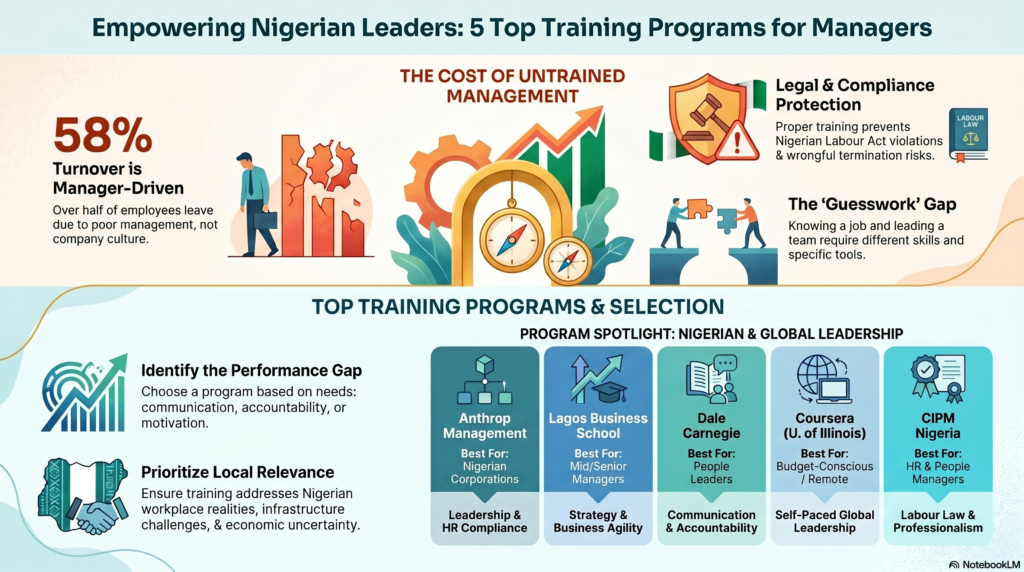
A survey by the Society for Human Resource Management (SHRM) found that 58% of employees who left their jobs did so because of their manager not the company. That is a huge number. And in Nigeria, where replacing staff can be costly and disruptive, that is money walking out the door every single time a good employee resigns.
Human resource management Nigeria experts consistently flag poor leadership as one of the top reasons for high staff turnover in Nigerian companies. The solution is not always paying more. Often, it is training your managers to lead better.
Here is what is also important. Nigerian labour law governed primarily by the Labour Act and other related regulations puts responsibilities on employers to maintain a fair, safe, and properly managed work environment. When managers are untrained, they can inadvertently violate these rules through improper disciplinary procedures, wrongful termination, or failure to maintain proper records. That creates legal and financial risk for your business.
The importance of leadership training programs in Nigeria, therefore, goes beyond just performance. It is also about protecting your business legally and operationally.
Also read: Executive Leadership Training in Nigeria.
Subscribe to get exclusive insights you won’t find anywhere else.
5 Leadership Training Programs for Managers Worth Considering.
Here are five structured training programs for managers that are practical, accessible, and relevant for Nigerian businesses.
1. Anthrop Management Limited: Corporate Leadership Development Programme
Best for: Nigerian businesses across all sectors
Anthrop Management Limited is one of Nigeria’s most respected HR consulting and training firms. Their Corporate Leadership Development Programme is specifically designed for the Nigerian business environment. This is not a one-size-fits-all international course copied and pasted into a Lagos conference room. The programme is built around real challenges Nigerian managers face managing diverse teams, dealing with power and infrastructure disruptions, motivating staff during economic uncertainty, and leading through rapid business change.
The programme covers emotional intelligence, conflict resolution, performance management, team building, and strategic communication. What makes it especially valuable for business owners is that it also connects leadership to human resource management Nigeria best practices including how managers should handle disciplinary issues, performance reviews, and staff documentation in line with Nigerian labour law.
Anthrop Management Limited also offers customised in-house programmes for organisations that want training tailored to their specific needs, industry, and team size.
What you get:
- Practical, Nigeria-specific content
- Workshops, coaching, and group exercises
- Customised programmes for companies
- Post-training support and follow-up
Who it is for: Supervisors, department heads, senior managers, and executives in Nigerian organisations
2. Lagos Business School (LBS): Management Acceleration Programme
Best for: Mid-level and senior managers ready to move to the next level
Lagos Business School, part of Pan-Atlantic University, is one of the most respected business schools in Africa. Their Management Acceleration Programme is designed for managers who want to develop strong strategic thinking, leadership agility, and business decision-making skills.
What sets LBS apart is their faculty. Many of their instructors have led real Nigerian and African businesses. The content is grounded in African and Nigerian business realities not just theories from Western business schools.
The programme covers strategic leadership, financial acumen for non-finance managers, people management, and managing change in organisations. For business owners, sending a key manager through LBS can be a genuine investment in the long-term capacity of their business.
Cost range: Varies per programme. Contact LBS directly at www.lbs.edu.ng for current pricing.
What you get:
- World-class African business education
- Networking with other top Nigerian professionals
- Practical case studies from African businesses
- Certificate of completion
3. Dale Carnegie Training: Leadership Training for Managers
Best for: Managers who need to improve communication, motivation, and team performance
Dale Carnegie Training has over 100 years of experience developing leaders around the world. Their Leadership Training for Managers course is one of the most widely used leadership training programs globally and it is available in Nigeria.
The programme is built around what Carnegie calls the “5 Drivers of Leadership Success.” It helps managers understand how to motivate people, build trust within teams, and align individual work with company goals.
The course also includes an eight-step planning process that managers can use immediately to set performance targets and hold their teams accountable. This is especially useful for Nigerian businesses where target-setting and accountability are often major weak points.
The programme is available in-person or online, making it flexible enough for Nigerian managers with busy schedules.
What you get:
- Practical skills that can be applied on the very next working day
- Focus on communication and people motivation
- Tools for setting and tracking team performance goals
- Certificate of completion
Why it works for Nigeria: The focus on accountability and motivation directly addresses two of the biggest challenges for managers in Nigerian businesses.
4. Coursera: Leadership and Management Specialisation (University of Illinois)
Best for: Managers who prefer self-paced online learning at low cost
Coursera is one of the world’s leading online learning platforms. The Leadership and Management Specialisation offered through the University of Illinois is one of their most popular leadership training programs for working professionals.
The specialisation covers four key areas:
- Designing and executing your leadership brand
- Managing people and teams
- Influencing stakeholders and building networks
- Managing the organisation
For Nigerian managers who cannot afford to travel or take time off for in-person training, Coursera offers a flexible, high quality alternative. You learn at your own pace, from your phone or laptop, and still earn an internationally recognised certificate.
Cost: The individual courses can be audited for free. Certificate tracks typically cost between $39 and $79 per month. Coursera also offers financial aid for those who cannot afford the full fee.
What you get:
- World-class university content
- Self-paced learning (great for busy managers)
- Internationally recognised certificate
- Community of global learners
Why it works for Nigeria: The low cost and flexible format make it one of the most accessible managers training options for Nigerian SMEs that cannot afford high-cost in-person programmes.
5. CIPM Nigeria: People Management and Leadership Programme
Best for: HR managers, business owners, and people managers who want to connect leadership to compliance
The Chartered Institute of Personnel Management of Nigeria (CIPM) is the professional body for HR and people management in Nigeria. Their People Management and Leadership Programme is one of the most relevant training programs for managers in the country because it is built specifically around Nigerian workplace laws, HR best practices, and the realities of managing people in Nigerian organisations.
The programme covers leadership skills, performance management, and crucially how to manage people in line with Nigerian labour law and HR compliance requirements. This includes understanding the Labour Act, managing employee records, handling terminations properly, and ensuring payroll compliance Nigeria standards are met.
For business owners who want their managers to lead people AND protect the business legally, CIPM’s programme is an excellent choice.
Cost range: Contact CIPM directly at www.cipmnigeria.org for current rates and programme schedules.
What you get:
- Nigeria-specific HR and leadership content
- Understanding of labour law and compliance
- Certificate from Nigeria’s official HR professional body
- Practical tools for managing people legally and effectively
Subscribe to get exclusive insights you won’t find anywhere else.
How to Choose the Right Training Program for Your Managers
Not every programme works for every business. Here is a simple guide to help you pick the right one.
Step 1: Identify the gap What is your manager struggling with? Is it communication? Accountability? Motivation? Knowing the specific problem helps you choose a programme that solves it.
Step 2: Consider your budget If budget is tight, start with Coursera or an online option. If you can invest more, consider Anthrop Management Limited’s custom programmes or LBS.
Step 3: Think about format Does your manager have time for an in-person programme? Or do they need something flexible and online? Match the format to their schedule.
Step 4: Check for local relevance An international programme is great. But make sure it covers Nigerian workplace realities especially if you want your managers to understand human resource management Nigeria and labour law Nigeria properly.
Step 5: Measure the results Set clear goals before the training starts. After the programme ends, track changes in team performance, staff retention, and business results. Good training should show measurable improvement.
Real-Life Nigerian Business Scenario
Let us look at a real example.
A retail company in Lagos had five store managers. Customer complaints were high. Staff kept leaving. Sales were inconsistent from store to store. The owner assumed the problem was the products or the location. After an HR review, the real problem was clear: none of the five managers had ever received any managers training. Each one was leading by guesswork.
The company enrolled all five managers in a combined programme an Anthrop Management Limited in-house workshop covering leadership, accountability, and performance management, followed by self-paced Coursera courses on people management.
Within three months:
- Customer complaints dropped by 35%
- Staff turnover fell significantly
- Sales performance became more consistent across all five stores
- Two of the managers were promoted to area supervisors
This is what happens when you invest in leadership training programs. The business did not change. The product did not change. The managers changed and everything else followed.
Key Benefits of Training Programs for Managers
Here is what your business gains when you invest properly in training programs for managers:
- Better team performance. Trained managers get more from their teams
- Lower staff turnover. People stay longer when they have good managers
- Fewer HR problems. Trained managers handle people issues without creating legal risk
- Stronger accountability. Managers know how to set clear targets and track results
- Better compliance. Managers understand labour law Nigeria and payroll compliance Nigeria requirements
- Higher revenue. Productive teams under good leaders deliver better business results
Common Mistakes Nigerian Businesses Make with Manager Training
1. Promoting without training You cannot make someone a manager just because they are your best salesperson or most loyal employee. Promote and train at the same time.
2. One workshop and done Leadership development is ongoing. A single two-day workshop will not transform anyone. Look for programmes with follow-up, coaching, and continued learning.
3. Training only junior staff Senior managers also need development. Leadership does not stop growing at a certain level.
4. Ignoring measurement If you do not measure the impact of training, you will never know if it worked. Set clear benchmarks before the programme starts.
5. Choosing the cheapest option without checking quality Cheap training that does not work is more expensive than good training that does. Always check the curriculum, facilitators, and track record.
6. Skipping compliance training Many Nigerian businesses forget to include training on labour law Nigeria and payroll compliance Nigeria. This is a serious mistake that can result in legal disputes, staff grievances, and regulatory penalties.
Frequently Asked Questions (FAQs)
What are training programs for managers?
They are structured programmes that teach people in management roles how to lead teams, communicate effectively, manage performance, and make better decisions. They can be in-person, online, or a mix of both.
Why do Nigerian businesses need leadership training programs?
Nigerian businesses face unique challenges economic pressure, high staff turnover, and complex workplace dynamics. Without properly trained managers, these challenges quickly become crises. Leadership training programs help managers handle pressure, motivate teams, and grow the business sustainably.
Who needs training programs for managers?
Any person who manages people needs this training. This includes team leads, supervisors, department heads, HR managers, branch managers, and even business owners who directly manage staff.
How much do managers training programs cost in Nigeria?
Costs vary widely. Online programmes like Coursera can cost as little as ₦30,000 to ₦50,000 per person. Local in-person programmes range from ₦100,000 to ₦500,000 per person. Customised corporate programmes can cost more depending on scope and duration. Always compare value not just price.
What is the connection between leadership training and labour law Nigeria?
Untrained managers often create legal problems for businesses through improper disciplinary processes, wrongful terminations, or poor employee record-keeping. Leadership training programs that include human resource management Nigeria content help managers lead people in line with Nigerian labour law, reducing legal risk for the business.
Can I create an in-house training program for my managers?
Yes. In-house programmes can be powerful because they are tailored to your specific business. But make sure the person facilitating the training has real leadership experience and that the content is relevant to your industry and the realities of managing teams in Nigeria.
Subscribe to get exclusive insights you won’t find anywhere else.
Conclusion
Investing in the right training programs for managers is one of the highest-return decisions a Nigerian business owner can make. Your managers are the bridge between your business strategy and your team. When they lead well, everything works better. When they do not, no strategy in the world will save you.
The five programmes covered in this article from Anthrop Management Limited’s Nigeria-specific corporate training to CIPM’s compliance-focused people management programme give you strong options at different price points and formats. Whether you prefer in-person, online, or a customised corporate solution, there is a leadership training program on this list that fits your needs.
Remember: great managers are not born. They are trained. And the businesses that train their managers will always outperform those that do not.
Ready to Build Managers Your Business Can Actually Rely On?
At Anthrop Management Limited, we help Nigerian businesses build strong, capable leadership teams through tailored managers training programmes, executive coaching, and comprehensive HR consulting.
- Leadership training programs
- Recruitment and talent management
- Payroll compliance Nigeria support
- HR policy development and labour law advisory
- Human resource management Nigeria solutions