
Table of Contents
Introduction: One Wrong Hire Can Cost You More Than You Think
Let’s be honest. Hiring the wrong person is one of the most expensive mistakes any Nigerian business can make. The cost of a bad hire in Nigeria goes far beyond just paying a salary. It affects your team, your clients, your reputation, and your bottom line.
Whether you run a small business in Lagos, a mid-sized company in Abuja, or a growing firm in Port Harcourt, bad hiring decisions hurt. And many business owners don’t even realise the full damage until it’s too late.
In this article, we’ll break down exactly what a bad hire costs, why it happens so often in Nigeria, and what you can do right now to avoid it.
What Is a “Bad Hire” and Why Does It Happen?
A bad hire is when you bring someone into your company and they turn out to be the wrong fit. It could mean they don’t have the skills they claimed. It could mean they have poor work habits. Or it could simply mean their values don’t match your company culture.
In Nigeria, bad hires happen for many reasons:
- Rushing the hiring process. Many companies hire out of desperation, not strategy
- No structured interview process. Candidates are judged on first impressions, not actual competence
- Weak background checks. Certificates are not verified, references are not called
- No clear job description. When you don’t know what you need, you can’t find the right person
- Personal connections over merit. “Managing Director’s cousin” gets hired ahead of the best candidate
Sound familiar? These are common patterns across many Nigerian organisations. And they all lead to the same painful outcome a bad hire.
Also read: How to Hire the Right Employees in Nigeria.
Subscribe to get exclusive insights you won’t find anywhere else.
The Real Cost of a Bad Hire in Nigeria
This is the section most business owners need to read very carefully. The cost of a bad hire in Nigeria is not just about the salary you paid. It goes much deeper.
1. Financial Costs
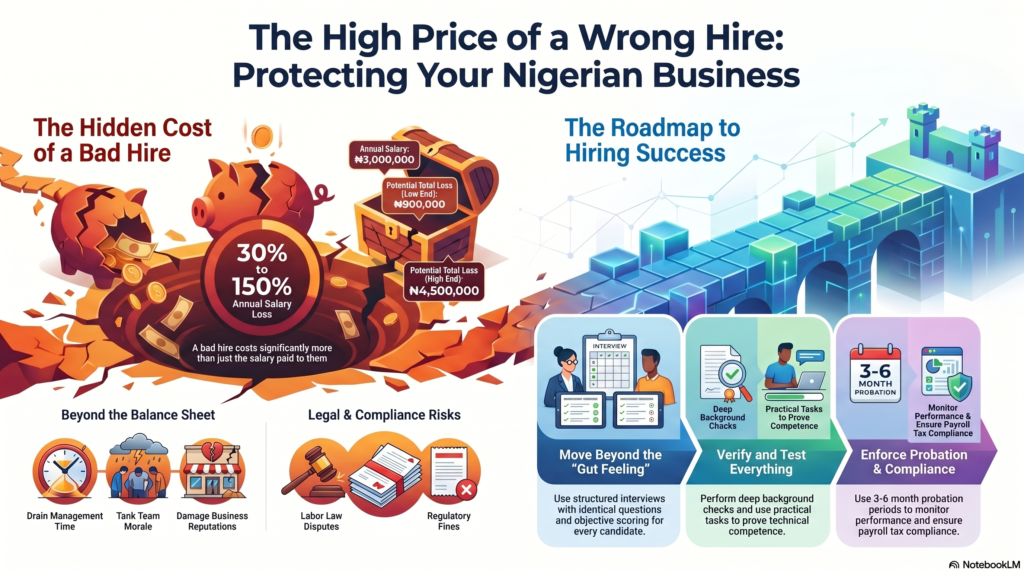
According to global HR research, a bad hire can cost a business anywhere from 30% to 150% of that employee’s annual salary. In Nigeria, that means if you hired someone at ₦3,000,000 per year and they turned out to be wrong for the role, you could lose between ₦900,000 and ₦4,500,000 in total losses.
How? Let’s count it up:
- Recruitment costs. Job adverts, agency fees, time spent interviewing
- Onboarding and training. You spent weeks or months training someone who won’t stay
- Lost productivity. A poor performer slows down the whole team
- Customer loss. Bad employees push clients away
- Termination costs. Including severance pay, which is protected under labour law Nigeria
This is not a small issue. For small and medium-sized businesses (SMEs) in Nigeria, one bad hire can create a financial hole that takes months to recover from.
2. Time Costs
Think about how long it takes to hire one person. Weeks of reviewing CVs. Days of interviews. Another few weeks of onboarding. Then a few more months before you realise they’re not working out. Then you start all over again.
That’s months of your time and your management team’s time wasted.
3. Team Morale Damage
When one person is not pulling their weight, it affects everyone around them. Other staff members get frustrated. They take on extra work. Some of your best employees start looking for another job.
One bad hire can trigger a chain reaction that damages your entire team.
4. Damage to Your Business Reputation
Imagine a customer service officer who is rude to clients. Or a finance officer who handles money carelessly. One bad hire in the wrong role can destroy relationships it took years to build.
In Nigerian business environments, where word of mouth and reputation matter deeply, this is a serious risk.
Why Human Resource Management in Nigeria Is Often Underestimated
Many Nigerian businesses, especially SMEs still treat HR as an admin function. Someone who handles attendance, leave forms, and payslips. But Human Resource Management in Nigeria is so much more than that.
Proper HR management involves:
- Strategic workforce planning
- Structured recruitment and selection
- Staff training and development
- Performance management
- Compliance with Nigerian labour laws
- Payroll management and tax compliance
When businesses skip these processes, bad hires become almost inevitable. You end up with people in roles they’re not suited for, with no system in place to catch problems early.
This is exactly why many growing businesses are turning to HR consulting Nigeria services. Instead of guessing, they work with professionals who have built the systems, seen the mistakes, and know exactly what works.
How to Avoid a Bad Hire: A Step-by-Step Guide
You don’t need a huge budget or a big team to hire better. You just need a system. Here’s a practical step-by-step approach:
Step 1: Write a Clear Job Description
Before you post any advert, be crystal clear about:
- What the person will do every day
- What qualifications and experience they need
- What success looks like in the first 90 days
- What kind of personality fits your team
A vague job description attracts the wrong applicants. Be specific.
Step 2: Use a Structured Interview Process
Do not interview by gut feeling alone. Create a list of questions that test:
- Skills and experience
- Problem-solving ability
- Cultural fit
- Values alignment
Ask every candidate the same questions. Score their answers. Compare them objectively.
Step 3: Verify Everything
Check academic certificates. Call their references, not just the ones they gave you, but people who have worked with them in previous roles. Run background checks where necessary.
In Nigeria, certificate forgery and inflated CVs are real problems. Don’t skip this step.
Step 4: Use Assessments and Test Tasks
For technical roles, give candidates a practical test. For sales roles, do a mock pitch. For finance roles, give them a real problem to solve. This tells you far more than a CV ever will.
Step 5: Have a Probation Period and Monitor Performance
Your offer letter should clearly state a probation period, typically three to six months. During this period, set clear performance goals and review them regularly.
This gives you time to correct mistakes before they become expensive.
Step 6: Work With HR Professionals
If recruitment is not your strength, don’t pretend it is. HR outsourcing Nigeria services exist exactly for this reason. You outsource what you’re not good at in logistics, accounting, and legal, so why not HR?
A qualified HR consultant can help you build a recruitment process that works, saving you time, money, and headaches.
Subscribe to get exclusive insights you won’t find anywhere else.
Payroll Compliance Nigeria: Why It Matters When You Hire
Many business owners focus entirely on finding the right person but forget about what comes after proper payroll and compliance.
Payroll compliance Nigeria involves:
- Accurate calculation of salaries, taxes, and deductions
- Pension remittances to PFAs (Pension Fund Administrators)
- PAYE (Pay As You Earn) tax remittances to the relevant state revenue authority
- Compliance with the Personal Income Tax Act (PITA) and other regulations
- Proper documentation of employee compensation
Getting this wrong creates legal and financial risks. The Nigerian Pension Commission (PenCom) and relevant tax authorities do audit companies. Fines, back-payments, and legal actions are real consequences.
When you work with a proper HR consulting firm, payroll compliance is handled for you, correctly, every time.
Also read: 5 Proven Staffing Agencies in Nigeria
Real-World Example: The Small Business That Learned the Hard Way
Let’s look at a real scenario. Imagine a growing logistics company in Lagos, let’s call them “SwiftMove Logistics.” They had 15 staff and were expanding fast.
They needed a new Operations Manager quickly. Instead of following a proper hiring process, the CEO’s cousin was recommended. He had a good CV and spoke well in the interview. So they hired him.
Within three months, the problems began. He was consistently late. He mishandled a major client account. Two key drivers quit because of poor management. SwiftMove lost two clients and ₦4.2 million in contracts.
They eventually let him go, but by then, the damage was done. They had to start the hiring process again, repair client relationships, and rebuild team morale. All because they skipped the basics.
Had they worked with an HR consulting firm from the start, a proper vetting process would likely have revealed the red flags early. Their situation would have been very different.
Benefits of Getting Hiring Right
When you build a strong recruitment process, the results are powerful:
- Lower staff turnover. People hired well tend to stay longer
- Higher productivity. The right person in the right role performs better, faster
- Stronger team culture. Good hires raise the standard for everyone around them
- Better customer experience. Happy, competent staff serve customers better
- Reduced legal risk. Proper processes protect you under labour law Nigeria
- Faster business growth. Great teams execute better and faster
Common Mistakes Nigerian Businesses Make When Hiring
Avoid these traps:
- Hiring out of urgency. When you’re desperate, you settle. Plan your hiring in advance.
- Relying only on referrals. Referrals are good, but they must still go through the proper process.
- Ignoring cultural fit. Skills matter, but so does attitude. A technically skilled person who doesn’t fit your team can still be a bad hire.
- Not reading the employment contract carefully. A poorly written contract creates problems later, especially under labour law Nigeria.
- Skipping the probation review. Many companies forget to formally review employees at the end of probation. Then six months later, they’re stuck with someone they should have let go.
- Not investing in HR. Treating HR as an afterthought instead of a strategic function is one of the biggest mistakes growing Nigerian businesses make.
Frequently Asked Questions (FAQs)
What is the cost of a bad hire in Nigeria?
The cost of a bad hire in Nigeria typically ranges from 30% to 150% of the employee’s annual salary. This includes recruitment costs, training time, lost productivity, client damage, and termination expenses. For many SMEs, this can run into millions of Naira.
How does a bad hire affect a Nigerian business?
A bad hire affects a business in multiple ways financially, culturally, and operationally. It wastes money, drains management time, reduces team morale, and can damage client relationships.
What is HR consulting in Nigeria?
HR consulting Nigeria refers to professional services that help businesses manage their human resources more effectively. This includes recruitment, staff training, performance management, payroll compliance, and labour law advisory.
Why is payroll compliance important in Nigeria?
Payroll compliance Nigeria is important because businesses are legally required to deduct and remit taxes, manage pension contributions, and follow the provisions of the Personal Income Tax Act. Non-compliance can result in fines and legal action from tax authorities.
What does labour law Nigeria say about bad hires and termination?
Under labour law Nigeria, employers must follow due process when terminating an employee. This usually involves giving proper notice (or pay in lieu), conducting a fair process, and ensuring all outstanding entitlements including severance pay and pension are settled correctly. Getting this wrong can lead to labour disputes.
Who needs HR outsourcing in Nigeria?
HR outsourcing Nigeria is ideal for small and medium-sized businesses that don’t have a dedicated HR department but still need structured recruitment, payroll management, and compliance support. It’s also valuable for larger organisations that want to improve the quality and efficiency of their HR operations.
How can I avoid making a bad hire in Nigeria?
Start with a clear job description, use a structured interview process, verify all credentials, conduct practical assessments, and use a proper probation period. Working with an experienced HR consulting firm also significantly reduces the risk of a bad hire.
Conclusion: The Right Hire Changes Everything
Hiring is one of the most important decisions any business owner makes. And in Nigeria, where business environments are competitive and margins are often tight, a bad hire is something you simply cannot afford.
The cost of a bad hire in Nigeria goes far beyond salary. It affects your team, your clients, your finances, and your growth. But with the right process, the right support, and a commitment to doing hiring properly you can protect your business and build the team that will take it to the next level.
Human Resource Management in Nigeria is not just an administrative function. It is a strategic advantage. The businesses that get hiring right are the ones that grow faster, retain better talent, and win more clients.
Don’t leave your most important decisions to chance.
Ready to Build a Stronger Team?
Subscribe to get exclusive insights you won’t find anywhere else.
Our team provides professional HR consulting, recruitment support, payroll compliance, and labour law advisory for businesses across Nigeria. Whether you’re hiring your first employee or scaling a team of 100, we have the experience and tools to help you get it right every time.