
Table of Contents
The most common payroll mistakes Nigerian businesses make include paying staff late, calculating salaries incorrectly, not remitting PAYE tax to the government on time, skipping pension contributions, failing to register workers with NSITF, and not keeping proper payroll records. These payroll errors in Nigeria cost businesses far more than most owners realise in penalties, back payments, legal disputes, and staff trust that is very hard to win back.
If you are a business owner or manager in Nigeria, this article is for you. It explains what payroll mistakes look like in real life, why they happen, what they cost, and exactly what you can do to fix them. By the end, you will know how to protect your business and your staff from the damage that payroll errors in Nigeria cause every day.
What Is Payroll and Why Does It Matter So Much in Nigeria?
Payroll is the system a business uses to pay its staff. It covers how much each person earns, what is deducted from their pay (like tax and pension), and when the money is paid. It also includes all the reports and records that prove the business is paying people correctly.
Think of payroll like a scorecard. Every month, your business scores points by paying staff the right amount, at the right time, with the right deductions. If you miss any of those things, the scorecard turns red and red means problems.
In Nigeria, payroll is not just an internal business matter. It involves multiple government agencies. Your staff’s tax goes to the State Internal Revenue Service (SIRS). Their pension goes to a licensed Pension Fund Administrator (PFA). Their workplace injury cover goes to the Nigeria Social Insurance Trust Fund (NSITF). If any of these payments are wrong or late, your business is breaking the law even if the mistake was accidental.
Payroll compliance in Nigeria means getting the right amount to the right person and the right government agency at the right time. Miss any of those four things and you have a payroll error and possibly a legal problem.
What Payroll Errors in Nigeria Actually Cost: A Quick Reference
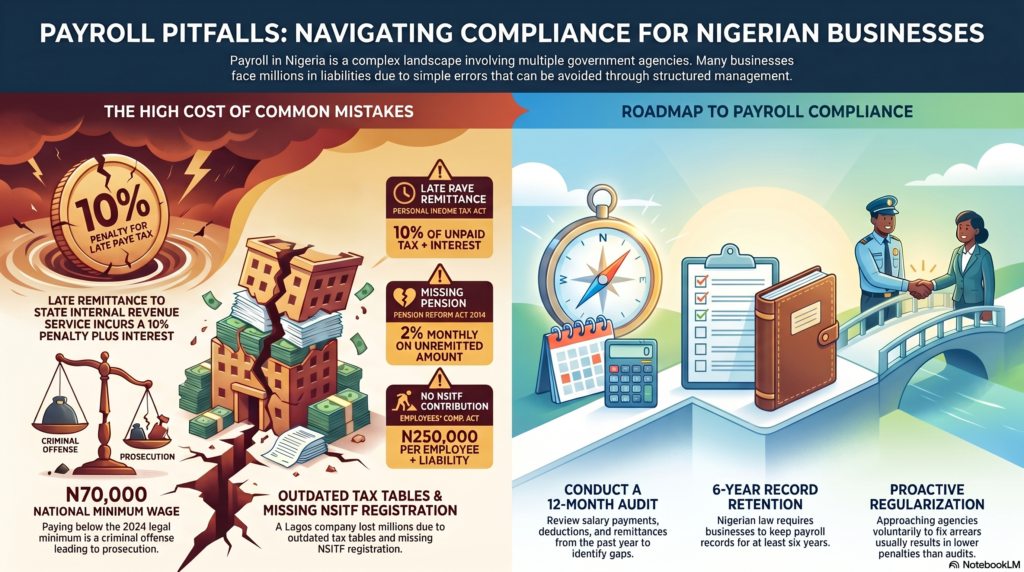
Before we look at each mistake in detail, here is a table showing the most common payroll errors in Nigeria, which law they break, and what the business can be made to pay. These are real penalties from real Nigerian laws not estimates.
| Payroll Error | Law Broken | Penalty / Cost |
| Late PAYE remittance | Personal Income Tax Act | 10% of unpaid tax + interest |
| No pension contribution | Pension Reform Act 2014 | 2% monthly on unremitted amount |
| No NSITF contribution | Employees’ Compensation Act 2010 | N250,000 per employee + full liability |
| Paying below minimum wage | National Minimum Wage Act 2024 | Criminal prosecution, fines, arrears |
| Wrong or missing payslips | Labour Act Cap L1 (2004) | Labour disputes, NIC claims |
| No ITF contribution (5+ employees) | Industrial Training Fund Act | Prosecution + penalty fees |
These penalties add up fast. A business with 20 staff that has been making payroll errors in Nigeria for two years can face a combined liability of several million naira far more than the cost of doing payroll properly from the start.
Also read: Top Human Resource Services in Lagos Nigeria (2026 Guide)
5 Best Recruitment Companies in Lagos Nigeria (2026 Guide)
5 Types of Employee Training Programs Offered by Top Companies.
The 7 Biggest Payroll Mistakes Nigerian Businesses Make.
MISTAKE 1: Paying Staff Late or Inconsistently
This is one of the most damaging payroll mistakes Nigerian businesses make. Some businesses pay salaries whenever cash is available. Others pay in two or three instalments across the month. Others simply pay late with no explanation.
Think about it from a staff member’s point of view. They have rent due at the end of the month. They have school fees, groceries, and transport costs. When their salary does not arrive on time, all of those things are affected. It causes stress. It damages trust. And it makes them start looking for another job.
Under the Nigerian Labour Act, wages must be paid on the agreed date and in full. Consistently late payment is a breach of the employment contract and gives employees legal grounds for a complaint at the National Industrial Court.
>> According to a 2023 Gallup workforce survey, employees who consistently receive their salary late are 43% more likely to be actively looking for a new job — Gallup, 2023.
THE FIX: Set a fixed payroll date every month and stick to it. Communicate the date to all staff in writing. If your cash flow makes this difficult, speak to a payroll management consultant about how to restructure your payment schedule to work within your business cycle.
MISTAKE 2: Wrong Salary Calculations
This happens when the wrong basic salary is used, when allowances are left out or added incorrectly, when overtime is not calculated properly, or when deductions are made without the correct formula. It is one of the most common payroll errors in Nigeria, especially in businesses that use spreadsheets instead of dedicated payroll software.
A small error in one month can multiply. If a staff member is underpaid by N15,000 in January and the mistake is not caught, they may be underpaid again in February, March, and beyond. By the end of the year, the business may owe that employee N180,000 in unpaid salary plus interest and potential legal costs if the employee raises a formal complaint.
Overpayment is also a problem. If an employee is overpaid and the business tries to recover the excess, this must be done correctly under Nigerian law. You cannot simply deduct from the next month’s salary without the employee’s written consent.
THE FIX: Review your salary calculation template at least once a year. Make sure it accounts for all components of each employee’s pay correctly basic salary, housing allowance, transport allowance, and any other contractual payments. Use a payroll tool or engage a payroll service provider for accurate processing.
MISTAKE 3: Not Remitting PAYE Tax Correctly or on Time
PAYE stands for Pay As You Earn. It is the income tax that every employed Nigerian worker must pay. As the employer, you are required to deduct the correct amount from each employee’s salary every month and send it to the State Internal Revenue Service (SIRS) of the state where the employee works.
This is one of the payroll mistakes in Nigeria that catches businesses off guard. Many employers either do not deduct PAYE at all, deduct the wrong amount because they are using the wrong tax table, or deduct the right amount but forget to remit it to the state tax authority. All three are wrong, and all three carry penalties.
The penalty for late PAYE remittance is 10% of the unpaid tax amount, plus interest. If your business has 15 employees and has been under-remitting PAYE for two years, the combined back-payment and penalties can easily exceed N1 million.
>> The Lagos Internal Revenue Service reported a significant increase in PAYE enforcement actions against SMEs between 2021 and 2023, with back-payment demands averaging N800,000 per business — LIRS Enforcement Report, 2023.
THE FIX: Use the correct PAYE tax table for each employee’s income level and state of employment. Remit the deducted tax to the relevant state SIRS every month typically by the 10th of the following month. Keep a record of every remittance with the receipt or confirmation as proof of compliance.
MISTAKE 4: Missing or Late Pension Contributions
The Pension Reform Act 2014 requires every employer with three or more employees to enrol all qualifying staff in the Contributory Pension Scheme. The employer must contribute at least 10% of each employee’s monthly emolument, and the employee contributes at least 8%. The total 18% must reach the employee’s Retirement Savings Account within seven working days of salary payment.
This is one of the most widely ignored payroll compliance obligations in Nigeria. Many small and medium businesses simply do not know about it, or they know but treat it as optional. It is not optional. The penalty for late remittance is 2% of the total unpaid contribution for every month of delay. For a business with 10 staff earning an average of N150,000 per month, a two-year pension backlog can result in a liability exceeding N3.5 million.
If an employee discovers that their employer has never made pension contributions on their behalf even after years of employment they can file a complaint with the National Pension Commission (PenCom). PenCom has the authority to investigate, sanction, and publicly name non-compliant employers.
THE FIX: Register your business and all qualifying employees with a licensed Pension Fund Administrator (PFA) immediately. Set up your payroll system to calculate and remit pension contributions automatically within seven working days of each salary run. If you have a backlog, seek professional advice on how to regularise your position with PenCom.
MISTAKE 5: Paying Below the Legal Minimum Wage
Nigeria’s national minimum wage was revised in 2024 to N70,000 per month. Every employer regardless of size, sector, or location must pay every full-time employee at least this amount. Some states have set higher state minimum wages, and employers in those states must comply with whichever figure is higher.
This payroll mistake in Nigeria is common among businesses that employ junior, support, or casual staff cleaners, security guards, drivers, kitchen assistants, and factory workers. Some of these roles are traditionally paid very low salaries that have not been reviewed since the old minimum wage of N30,000 was in place.
Paying below the minimum wage is a criminal offence. It can result in prosecution of the business owners, payment of all unpaid arrears to affected staff, and significant fines.
THE FIX: Review your entire payroll against the current federal and applicable state minimum wage immediately. Identify every employee whose salary falls below the legal minimum and adjust their pay. Do this review annually and every time a minimum wage revision is announced.
MISTAKE 6: Not Registering Staff With NSITF
The Nigeria Social Insurance Trust Fund (NSITF) manages the Employee Compensation Fund. Every employer is required to register all workers with NSITF and contribute 1% of their total monthly payroll to the fund. This fund pays compensation to workers who are injured at work, become ill because of their job, or die as a result of a workplace incident.
Not registering with NSITF means your business has no protection if a worker is injured. The NSITF fund does not pay compensation for employers that are not registered and contributing. Instead, the employer becomes directly and personally liable for all medical costs, rehabilitation, income replacement, and in some cases, death benefits which can amount to millions of naira for a single incident.
THE FIX: Register your business and all employees with NSITF. Set up a payroll deduction that calculates and remits the 1% monthly contribution as part of your standard payroll run. This is a small cost that protects you from a potentially enormous liability.
MISTAKE 7: Not Keeping Proper Payroll Records
Many Nigerian businesses especially small ones run payroll from memory, from WhatsApp messages, or from a basic notebook. They have no payslips, no salary history, no record of deductions, and no documentation trail. This feels fine until something goes wrong.
If a staff member disputes their salary, you have no proof of what was paid. If a tax authority audits your business, you cannot demonstrate compliance. If an employee claims unpaid entitlements at the National Industrial Court, you cannot defend yourself without records. Poor record-keeping turns every payroll dispute into a case where the employee’s word carries more weight than the employer’s because the employer has nothing to show.
Under Nigerian law, payroll records must be kept for a minimum of six years. They must include salary details, tax deductions, pension contributions, NSITF contributions, and signed payslips or acknowledgement of payment.
THE FIX: Issue payslips to every employee every month without exception. Keep digital or physical payroll records covering at least the last six years. Store copies securely so they can be retrieved if needed. If you currently have no payroll records, start building them now and seek professional support to reconstruct what is missing.
Also read: Executive Leadership Training in Nigeria.
How to Lead Remote Teams Effectively in a Hybrid Work World.
5 Leading HR Consulting Firms in Nigeria Specialising in Labour Law Compliance
A Real Business Example: How Payroll Mistakes Cost a Lagos Company Over N2 Million
REAL BUSINESS EXAMPLE: Distribution company in Mushin discovers years of accumulated payroll errors
A fast-moving consumer goods distribution business in Mushin, Lagos, had been running payroll manually on a spreadsheet for four years. The owner processed salaries himself, usually two to three days after the agreed payment date. He was deducting what he believed was the correct PAYE amount from 18 staff members but had been using an outdated tax table since 2020. He had also never registered the business or its staff with NSITF.In 2024, the Lagos Internal Revenue Service sent the business a tax audit notice. The audit revealed four years of PAYE under-remittance. The back-payment demand, including the 10% penalty and interest, came to N1.36 million. Separately, a worker who had been injured on a delivery route in 2023 filed a compensation claim. Because the business was not registered with NSITF, the fund provided no cover. The employer was held directly liable for medical costs and income replacement totalling N740,000.The combined cost of these two payroll mistakes exceeded N2.1 million. A payroll compliance audit and proper setup at the start of the business would have cost less than N200,000 in total a fraction of what the errors ultimately cost.
What Payroll Compliance in Nigeria Does for Your Business
Getting payroll right is not just about avoiding fines. It has real, positive effects on your business. Here is what consistent payroll compliance in Nigeria delivers:
– Staff trust and retention. When employees are paid correctly and on time every month, they trust the business. Trust reduces staff turnover. Replacing a staff member costs between 50% and 200% of their annual salary — payroll compliance saves that cost.
– Legal protection. A business with clean payroll records, correct deductions, and documented compliance has strong protection against staff claims, tax audits, and regulatory inspections.
– Better financial planning. When payroll is structured and predictable, it is easier to manage your cash flow and plan for growth. Surprise penalty payments and back-payment demands destroy financial planning.
– A stronger reputation. Businesses that pay on time and treat staff fairly attract better candidates when they recruit. Word travels fast in Lagos. Your reputation as an employer affects who is willing to work for you.
– Smoother business operations. When payroll runs without errors or complaints, management time is freed up to focus on the business itself rather than dealing with disputes, corrections, and regulatory demands.
>> SHRM research shows that businesses with structured, compliant payroll practices report 35% fewer HR-related disputes and 28% lower staff turnover than businesses with informal payroll processes — SHRM, 2023.
How to Fix Payroll Mistakes in Nigeria: A Step-by-Step Approach
If your business is currently making any of the payroll mistakes covered in this article, here is a simple process to get things right:
Step 1 — Audit your current payroll. Review the last 12 months of salary payments. Check what was paid, when it was paid, what was deducted, and what was remitted to government agencies. Identify every gap.
Step 2 — Check your compliance status. Confirm whether your business is registered with NSITF, whether all staff are enrolled in the pension scheme, and whether PAYE remittances have been made correctly to the relevant State Internal Revenue Service.
Step 3 — Regularise any outstanding obligations. If you have unpaid pension, PAYE arrears, or NSITF obligations, address these proactively. Approaching the relevant agency voluntarily usually results in a better outcome than waiting for an audit or enforcement action.
Step 4 — Set up a proper payroll system. Whether you use dedicated payroll software or engage a payroll management firm, establish a system that calculates all components correctly, generates payslips, and remits contributions automatically.
Step 5 — Train whoever manages payroll. Make sure the person processing your payroll understands the current tax tables, pension rates, and compliance deadlines. If no one in your team has this knowledge, outsource payroll to a professional firm.
Step 6 — Review annually. Laws change. Minimum wage, PAYE tables, and pension rates are all updated periodically. Review your payroll setup at the start of each year to make sure it reflects the current legal requirements.
You do not need to fix everything at once. Start with the highest-risk areas PAYE remittance, pension contributions, and minimum wage compliance and work through the rest systematically. Getting started is what matters most.
Frequently Asked Questions About Payroll Mistakes in Nigeria
What are payroll mistakes in Nigeria?
Payroll mistakes in Nigeria are errors made in calculating, processing, or remitting staff salaries and the related statutory obligations. They include paying the wrong amount, paying late, deducting the wrong tax, not remitting pension on time, and not keeping proper payroll records. All of these can result in financial penalties, legal claims, or staff disputes.
What is payroll compliance in Nigeria?
Payroll compliance in Nigeria means processing staff salaries correctly and meeting all related legal obligations paying PAYE tax to the State Internal Revenue Service, remitting pension contributions within seven working days of salary payment, contributing 1% of payroll to NSITF, and paying at or above the national minimum wage. Businesses that meet all of these requirements are payroll compliant.
What happens if a Nigerian business makes payroll errors?
Depending on the type of payroll error in Nigeria, the business can face penalties from the relevant government agency, back-payment demands for unpaid tax or pension, claims from employees at the National Industrial Court, direct liability for workplace injuries if NSITF contributions were not made, and reputational damage that affects staff recruitment and retention.
How much does it cost to fix payroll errors in Nigeria?
The cost depends on how long the errors have been occurring and how many staff are affected. A PAYE audit that uncovers two years of under-remittance for 15 staff can result in a demand of over N1 million including penalties. Pension arrears for a business of similar size over the same period can add another N1 to N2 million. Fixing the errors early, before a formal audit or inspection, significantly reduces the total cost.
Who is responsible for payroll compliance in a Nigerian business?
The business owner or the most senior officer of the company is ultimately responsible for payroll compliance in Nigeria. In practice, day-to-day responsibility usually falls on the HR manager, finance manager, or payroll officer. Engaging a professional payroll management firm transfers the processing responsibility to specialists, but the business remains accountable for the outcome.
How can Anthrop Management Limited help with payroll mistakes in Nigeria?
Anthrop Management Limited offers payroll audits, payroll restructuring, ongoing payroll management, compliance regularisation support, and staff training on payroll processes. Whether you need to fix existing payroll errors in Nigeria or set up a compliant payroll system from scratch, our team will build a solution around your business size, structure, and budget.
Stop Payroll Mistakes From Hurting Your Business
Our team at Anthrop Management Limited provides HR consulting, payroll management, recruitment, and compliance support for businesses across Lagos and Nigeria. We handle your payroll the right way accurately, on time, and fully compliant with Nigerian law. Learn more about our human resource management services in Lagos, Nigeria.
Whether you are a startup running payroll for the first time or an established business looking to clean up years of payroll errors in Nigeria, we are ready to help.
Conclusion:
Every payroll mistake covered in this article is preventable. Late payments, wrong calculations, missed PAYE remittances, pension gaps, NSITF non-registration none of these have to happen. They happen when businesses treat payroll as a low-priority task rather than the critical compliance obligation it actually is.
The businesses that get payroll right do not spend millions fixing errors. They spend a predictable amount each month running payroll properly, and they use the time and money they save to grow. Payroll compliance in Nigeria is not a burden. It is a foundation. Get it right, and everything else in your business runs more smoothly.
If your business is currently making any of the payroll mistakes in this article, the best time to fix them was yesterday. The second-best time is today. Anthrop Management Limited is ready to help you get there.
References
1. Pension Reform Act 2014, Federal Republic of Nigeria
2. Labour Act Cap L1, Laws of the Federation of Nigeria 2004
3. Employees’ Compensation Act 2010, Federal Republic of Nigeria
4. National Minimum Wage Act (Amendment) 2024, Federal Republic of Nigeria
5. Personal Income Tax Act (PITA) Cap P8, Laws of the Federation of Nigeria
6. Industrial Training Fund Act Cap I9, Laws of the Federation of Nigeria 2004
7. Lagos Internal Revenue Service — PAYE Enforcement Report 2023
8. National Pension Commission (PenCom) — Annual Report 2023
9. SHRM — Payroll Compliance and HR Operations Research 2023
10. Gallup — State of the Global Workplace Report 2023