

Table of Contents
Introduction: The Straight Answer First
Yes, is HR a good career choice? Absolutely. In Nigeria today, Human Resource Management is one of the most in-demand and rewarding professional paths you can take. Companies across every industry banking, oil and gas, healthcare, manufacturing, tech, and the public sector are actively hiring HR professionals. And the demand keeps growing.
But like every career, HR is not for everyone. You need the right skills, the right mindset, and ideally the right professional certification to truly succeed. This article will walk you through everything you need to know what HR actually involves, what you can earn, how to get started, and what to expect along the way.
Whether you are a fresh graduate thinking about your career options, or someone already working who wants to switch into HR, this guide is written for you.
What Is Human Resource Management? A Simple Explanation
Human Resource Management or HR is the part of a business that handles everything related to people. Think of it this way. A company is like a football team. The CEO is like the coach. But the HR manager is the team manager who makes sure every player is in the right position, properly trained, paid correctly, and treated fairly.
Human Resource Management in Nigeria covers a wide range of tasks:
- Finding and hiring the right employees
- Writing job descriptions and employment contracts
- Managing salaries and payroll
- Making sure the company follows Nigerian labour laws
- Training and developing staff
- Handling staff complaints and disciplinary processes
- Planning how many people the company needs as it grows
- Managing staff exit processes properly
Every single business that has employees from a small restaurant in Ibadan to a large bank in Lagos needs some form of HR management. That is why trained HR professionals are always needed.
Is HR a Good Career Choice in Nigeria? What the Job Market Says
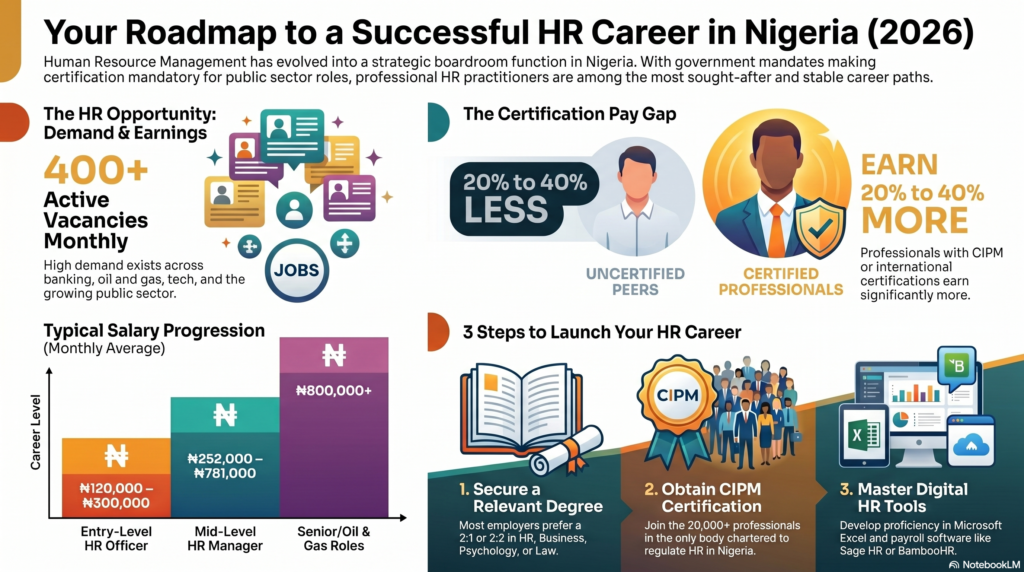
Let’s look at the numbers. Right now, there are nearly 400 active HR job vacancies listed across Nigerian job boards on any given month, spanning companies from startups to multinationals. Major organisations are actively seeking HR managers to oversee all HR functions and support organisational growth, with most roles requiring five to six years of progressive experience.
The sectors hiring most aggressively include:
- Banking and financial services — HR officers and managers in compliance-heavy environments
- Oil and gas — Some of the highest-paid HR roles in the country
- Multinationals and NGOs — Often require CIPM or international HR certifications
- Technology companies — Fast-growing sector with increasing HR needs
- Public sector — A very recent government directive has made this even more relevant
On that last point this is big news. In May 2026, the Federal Government reaffirmed the statutory authority of the Chartered Institute of Personnel Management of Nigeria (CIPM) as the foremost regulatory body for the HR profession in Nigeria, following a new circular that establishes mandatory professional certification requirements for officers occupying HR roles within Ministries, Departments, and Agencies (MDAs) of government.
In plain English: if you want to work in HR in the Nigerian public sector, you now need to be professionally certified. This has just made HR qualifications far more valuable than before.
Learn more about our Human Resource Management services in Nigeria
What Does an HR Professional Actually Do Every Day?
Let us break this down simply. An HR professional’s daily work depends on their role, but here are the most common tasks:
For an HR Officer (entry-level):
- Posting job adverts and screening CVs
- Scheduling interviews
- Maintaining employee records
- Supporting payroll processing
- Handling onboarding of new staff
For an HR Manager (mid to senior level):
- Leading the full recruitment process
- Writing and reviewing HR policies
- Ensuring the company complies with labour law Nigeria
- Managing staff performance and appraisals
- Advising management on people-related decisions
- Overseeing payroll compliance Nigeria. PAYE tax, pension contributions, and benefits
For an HR Consultant or Director (senior/specialist):
- Designing HR strategy for the whole organisation
- Managing HR outsourcing Nigeria relationships
- Advising on workforce restructuring
- Leading compliance audits
- Building leadership development programs
The higher you go, the more strategic the role becomes. You stop just managing processes and start shaping how an entire organisation handles its people.
What Can You Earn as an HR Professional in Nigeria?
Salary is one of the most common questions. Here is the honest picture:
Entry-level HR Officer: The average HR Officer salary in Nigeria ranges from ₦120,000 to ₦300,000 per month, with a median around ₦180,000 monthly across all industries and company sizes. Entry-level HR Officers at small companies may earn ₦80,000 to ₦130,000, while experienced HR Officers at multinationals, banks, or oil companies earn ₦300,000 to more.
HR Manager: A person working as a Human Resources Manager in Nigeria typically earns around ₦504,000 per month. Salaries range from ₦252,000 (lowest) to ₦781,000 (highest), including housing, transport, and other benefits.
What boosts your salary significantly:
Holding a CIPM certification can boost your salary by ₦100,000 to ₦300,000. An SHRM certification adds ₦200,000 to ₦500,000. Lagos salaries are about 30% higher than Abuja and 50% higher than Port Harcourt or Kano. The oil and gas industry pays 40–60% more than manufacturing for equivalent HR roles.
Certified professionals typically earn 20% to 40% more than uncertified peers at the same experience level.
The message is clear. Invest in your certification and your earnings climb significantly.
See how we help businesses find and retain top talent
How to Start a Career in HR in Nigeria: Step-by-Step
Here is a practical roadmap to enter and grow in HR consulting Nigeria and broader HR practice:
Step 1: Get the Right Degree
The standard educational requirement is a degree in Human Resources Management, Industrial Relations and Personnel Management, Business Administration, Psychology, or a related field with at least a Second Class Lower (2:2) classification. Many employers, particularly banks and multinationals, prefer a Second Class Upper (2:1).
Don’t have an HR degree? That is fine. A business administration, psychology, law, or social sciences degree is also a strong starting point.
Step 2: Get Your CIPM Certification
This is the most important professional step you can take as an HR person in Nigeria.
CIPM is the only body chartered to regulate the practice of HR in Nigeria, with a network of over 20,000 HR professionals.
CIPM administers online examinations which hold four times a year. The examining process is in five stages: Foundation, Intermediate I, Intermediate II, Professional I, and Professional II.
You can start the CIPM process as a student even while still in university. It typically takes 18 to 24 months to complete all levels if you study consistently.
Step 3: Build Practical Experience Early
Use your NYSC service year strategically. Proactively seek a primary assignment in the HR department of a company, NGO, or government agency. Treat your NYSC period as a full HR internship ask to be involved in recruitment drives, staff inductions, payroll processing, and employee welfare initiatives.
Step 4: Learn HR Technology
Modern HR is digital. Learn tools like:
- Payroll software (Sage HR, BambooHR, or local platforms)
- HRIS systems used by large organisations
- Microsoft Excel (essential for payroll and reporting)
- LinkedIn for talent sourcing
Step 5: Build Your Network
Join CIPM events, attend HR conferences in Lagos and Abuja, and connect with HR professionals on LinkedIn. Many opportunities in Nigeria come through who you know, not just what you know. Your professional network is a career asset.
Understand the cost of HR outsourcing in Nigeria
Real-World Example: Adaeze’s Journey into HR in Nigeria
Let’s make this real. Adaeze graduated with a B.Sc. in Business Administration from the University of Lagos in 2021. She wasn’t sure what career to pursue. During her NYSC year, she was posted to a manufacturing company in Ikeja and placed in the HR department.
She spent 12 months learning how to process payroll, write job offers, coordinate training sessions, and manage staff records. She fell in love with the work.
After NYSC, she enrolled with CIPM as a student member and started her exams. She got her first job as an HR Assistant at ₦120,000 per month at a mid-sized company. Within two years, she passed her CIPM Associate exams, moved to a larger firm as an HR Officer at ₦230,000 per month, and was promoted to HR Manager within three more years at ₦420,000 monthly.
Today, she advises her company’s leadership team on everything from hiring to payroll compliance Nigeria and staff development. She did it by starting early, getting certified, and staying consistent.
Adaeze’s story is not unique. It happens regularly for HR professionals in Nigeria who make the right moves early.
Benefits of Choosing HR as a Career in Nigeria
Here is why HR is a genuinely great career path in this country:
- Job security — Every company with employees needs HR support. It cannot be entirely automated
- Career growth — Clear progression from HR Officer to Manager to Director to Consultant
- Variety — No two days are the same. You work with people, strategy, law, and finance all at once
- Relevance — With new government mandates on HR certification, professionals are even more needed now
- Consulting opportunities — Experienced HR professionals can launch their own HR consulting Nigeria firms
- Cross-industry mobility — HR skills transfer across every industry in Nigeria and internationally
- Respect and influence — Senior HR professionals sit in boardrooms and shape company direction
Human Resource Management in Nigeria is no longer just an admin role. It is a respected, strategic profession that directly affects how organisations perform.
Common Mistakes People Make When Entering HR
Avoid these errors they slow careers down unnecessarily:
- Waiting too long to get CIPM certified — Many people plan to “do it later” and then spend years in junior roles they can’t move out of. Start CIPM as early as possible.
- Treating HR as only administrative work — If you only want to manage attendance sheets and leave forms, you will hit a ceiling fast. Learn the strategic side of HR workforce planning, compliance, business partnership.
- Ignoring labour law Nigeria — Many HR professionals in Nigeria do not properly understand the Labour Act, pension regulations, PAYE tax rules, or employee rights. This creates huge risks for the companies they work for. Make compliance your strength.
- Not networking within the profession — The HR community in Nigeria is active and connected. Not engaging with it means missing job opportunities, mentors, and industry knowledge.
- Avoiding payroll and numbers — Many people go into HR because they love people, not spreadsheets. But payroll compliance is a core skill. Learn it. It makes you far more valuable.
- Skipping the fundamentals early in your career — Some people want to jump straight into strategic HR roles without doing the hard groundwork. Spend time in recruitment, onboarding, and employee relations first. That foundation is what makes great HR leaders.
Frequently Asked Questions (FAQs)
Is HR a good career choice in Nigeria?
Yes. HR is a growing, stable, and rewarding career in Nigeria. Demand for trained HR professionals spans every industry public and private. With the right qualifications, especially CIPM certification, career growth is fast and earning potential is strong.
What qualifications do I need to work in HR in Nigeria?
You need a relevant degree (HR, Business Administration, Psychology, or similar) plus CIPM certification, which is the professional standard for HR practitioners in Nigeria. International certifications like SHRM are a bonus, especially for roles at multinationals.
How much does an HR professional earn in Nigeria?
Entry-level HR Officers earn between ₦80,000 and ₦180,000 per month. Mid-level HR Managers earn ₦250,000 to ₦500,000. Senior HR professionals and directors in top firms can earn ₦600,000 and above, particularly in oil and gas, banking, and multinationals.
What is Human Resource Management in Nigeria?
Human Resource Management in Nigeria covers all people-related functions within a business recruitment, payroll, labour law compliance, performance management, staff training, and workforce planning. It is a strategic function, not just an administrative one.
What is CIPM and why does it matter?
CIPM is the Chartered Institute of Personnel Management of Nigeria. It is the only legally authorised body that certifies and regulates HR professionals in Nigeria. Getting CIPM certified increases your earnings, improves your job prospects, and is now mandatory for public sector HR roles.
What is the difference between HR outsourcing and HR consulting?
HR outsourcing Nigeria means a company hires an outside firm to handle their HR functions entirely payroll, recruitment, compliance, and more. HR consulting Nigeria means an expert firm advises the company on HR strategy and problems, often while the company handles day-to-day HR internally. Both are growing services in Nigeria as businesses focus on their core functions.
Can I do HR consulting as a freelancer or start my own firm?
Yes. Many experienced HR professionals in Nigeria eventually start their own consulting practices. The key requirements are strong expertise, CIPM membership, a track record of results, and a network of business clients.
Conclusion: HR Is Worth It
Is HR a good career choice? Based on every angle job availability, salary potential, career growth, and social impact the answer is a firm yes.
Human Resource Management in Nigeria is evolving fast. It is no longer a back-office function. It is a boardroom conversation. Companies that manage their people well outperform those that don’t. And the professionals who make that possible trained, certified, strategic HR practitioners are in high demand.
If you enjoy working with people, solving problems, understanding the law, and helping organisations grow, HR is a career worth committing to. Get your CIPM certification. Build your experience. Learn the law. Stay current.
The opportunities are real. The profession is growing. And Nigeria needs more great HR professionals.
Take the Next Step With a Team That Knows HR
At Anthrop Management Limited, we help businesses and professionals get HR right. Whether you need recruitment support, payroll compliance management, HR consulting services, or advisory on labour law Nigeria our team has the experience to support you.
Contact Anthrop Management today to speak with an HR specialist. Let us help you build the people systems your business needs to grow.
References
- CIPM Nigeria — Membership and Certification Routes
- CIPM Nigeria — Federal Government Reaffirms CIPM as Regulatory Body for HR (May 2026)
- Profolio Nigeria — HR Officer Salary Guide (2024–2026)
- HeadHunter Nigeria — HR Manager Salary in Nigeria (2026)
- Profolio Nigeria — How to Get an HR Officer Job in Nigeria (Step-by-Step Guide)