

Table of Contents
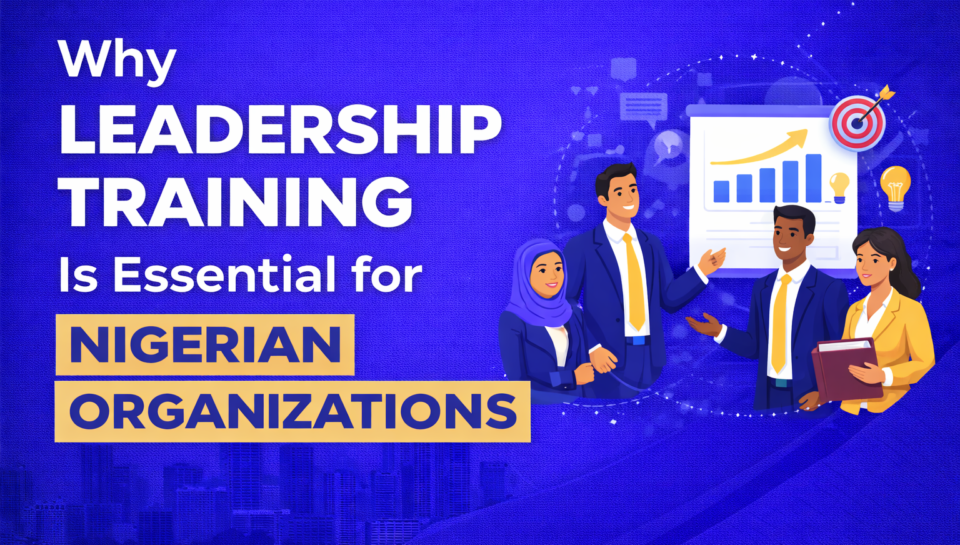
Leadership training is essential for Nigerian organisations because most managers in Nigeria are promoted based on technical performance rather than leadership ability. This means they are placed in charge of people and teams without the skills required to delegate effectively, manage conflict, drive performance, or retain staff. The result is disengaged teams, high turnover, poor execution of strategy, and businesses that cannot scale beyond their founders.
Leadership training Nigeria addresses this directly. It equips managers and executives with the specific skills needed to lead people well in the Nigerian business environment across sectors including financial services, manufacturing, telecoms, oil and gas, retail, and the public sector. Organisations that invest in structured corporate leadership training in Lagos and across Nigeria consistently outperform those that rely on technical ability alone.
This article explains the leadership gap in Nigeria, why leadership training is essential for Nigerian organizations, what effective leadership training covers, and how to choose the right executive leadership development program for your business.
The Leadership Gap in Nigerian Organisations: What the Data Shows
Nigeria has one of the youngest and fastest-growing workforces in the world. The National Bureau of Statistics reported a working-age population of over 83 million people as of 2023. This is a significant talent pool. The problem is not the size of the workforce. The problem is the leadership capability within it.
The majority of Nigerian organisations particularly SMEs and mid-sized companies promote their best technical performers into management roles without providing the training those individuals need to succeed as leaders. A top-performing sales executive becomes a sales manager. A brilliant engineer becomes an engineering team lead. A skilled accountant becomes a finance manager. In each case, the person’s technical knowledge got them the role. But technical knowledge alone does not make someone a good leader.
Only 18% of managers globally demonstrate a high natural talent for managing others — Gallup Global Workforce Report, 2023.
Gallup research shows that managers account for 70% of the variance in employee engagement across teams. Poorly trained managers are the single largest cause of disengaged workforces — Gallup, 2023.
Companies that invest in leadership development programs are 1.5 times more likely to be among the top financial performers in their industry — McKinsey & Company, 2023.
The Association for Talent Development found that organisations with strong leadership development programs achieve 23% higher profitability and 24% better talent retention than those without — ATD, 2023.
A 2023 PwC Nigeria survey found that 68% of Nigerian business leaders identified leadership succession and people management capability as a top-three operational concern for their organisation — PwC Nigeria CEO Survey, 2023.
Nigeria does not have a shortage of ambitious, intelligent people. It has a shortage of trained leaders. That gap is the difference between organisations that grow and those that stagnate.
Also read: 5 Most Common HR Compliance Mistakes
Why Leadership Training in Nigeria Matters at Every Level of the Organisation
One of the most common misconceptions about leadership training Nigeria is that it is only relevant for senior executives. In practice, leadership capability gaps exist and cause problems at every level of an organisation, from first-line supervisors to the boardroom. The table below maps the most common leadership gaps at each level in a typical Nigerian organisation and the training priorities that address them.
| Leadership Level | Common Gaps in Nigeria | Training Priority |
| Team Leaders | Unclear delegation, reactive management | Delegation, feedback, accountability |
| Middle Managers | Conflict avoidance, poor cross-team coordination | Conflict resolution, strategic alignment |
| Senior Managers | Inability to drive change, weak succession focus | Change leadership, executive presence |
| Executive / C-Suite | Short-term thinking, low emotional intelligence | Strategic vision, stakeholder management |
Each level of leadership failure has a cascading effect downwards. An executive who cannot communicate strategy clearly produces middle managers who cannot set direction. Middle managers who cannot set direction produce team leaders who cannot prioritise. Team leaders who cannot prioritise produce employees who feel lost, underperform, and leave. Leadership development is not a luxury reserved for the top of the organisation. It is a necessity at every level where people manage other people.
What Effective Corporate Leadership Training in Lagos and Nigeria Covers
Not all leadership training programs deliver the same results. Generic programs that teach broad leadership theory without connecting it to the Nigerian workplace, Nigerian business culture, and real organisational challenges tend to produce little lasting change. Effective corporate leadership training Lagos is specific, practical, and built around what managers and executives actually face in their daily roles.
The following are the core components of a leadership training program that produces measurable results in Nigerian organisations:
1. Self-Awareness and Emotional Intelligence
Leaders cannot manage others effectively until they understand themselves. Self-awareness training helps leaders identify their default behaviours under pressure, understand how their communication style affects others, and develop the emotional regulation needed to make sound decisions in high-stress situations. In the Nigerian workplace, where hierarchical norms can suppress honest feedback, emotional intelligence is one of the most underdeveloped and highest-impact leadership skills.
2. Communication and Feedback Skills
Poor communication is the most frequently cited cause of workplace dysfunction in Nigerian organisations. Leadership training covers how to give clear direction, how to deliver constructive feedback that improves performance rather than damaging morale, how to run productive meetings, and how to communicate strategy in a way that staff at every level can understand and act on.
REAL-WORLD EXAMPLE: Financial services company in Lagos transforms team performance through leadership communication training
A tier-2 microfinance bank in Lagos was experiencing declining branch performance across three of its seven Lagos branches. Exit interviews consistently cited ‘lack of direction from management’ and ‘poor communication from branch managers’ as the primary reasons for leaving. The bank engaged Anthrop Management Limited to deliver a structured corporate leadership training program in Lagos for all seven branch managers over eight weeks. The program focused on communication, delegation, and performance management. Within one quarter of completing the program, two of the three underperforming branches had returned to target performance levels, and staff attrition across all branches dropped by 31%.
3. Delegation and Accountability
Many Nigerian managers struggle to delegate effectively. Some hold on to tasks they should distribute because they do not trust their teams. Others delegate without providing adequate context, resources, or follow-up. Leadership training addresses both failure modes by teaching managers how to match tasks to team capability, communicate expectations clearly, and build accountability structures that produce results without micromanagement.
4. Conflict Resolution and Difficult Conversations
Avoiding conflict is one of the most common leadership failures in Nigerian organisations. Managers who avoid addressing underperformance, interpersonal tension, or team dysfunction allow small problems to grow into significant disruptions. Leadership training builds the skills and confidence to address difficult situations directly, professionally, and in a way that preserves working relationships.
5. Strategic Thinking and Business Acumen
Executive leadership development in Nigeria must go beyond people management skills. Senior leaders need to understand how to translate organisational strategy into team priorities, how to read financial and operational data to make better decisions, and how to think beyond their own function to contribute to the business as a whole. This is particularly relevant for Nigerian managers who are being prepared for senior or executive roles.
6. Succession and Talent Development
One of the most significant leadership failures in Nigerian organisations is the absence of succession planning. Many businesses are entirely dependent on one or two key individuals, and when those individuals leave, the organisation is left with a critical capability gap. Leadership training helps senior managers build a culture of talent development identifying high-potential staff, developing them deliberately, and creating the leadership pipeline the organisation needs to grow sustainably.
Leadership Training in Nigeria Must Reflect the Nigerian Business Context
This is where many generic or internationally designed leadership programs fall short. Nigeria’s business environment has specific characteristics that effective leadership training must account for:
Cultural hierarchy: Nigerian workplaces tend to have strong hierarchical norms. Staff are often reluctant to challenge their managers directly, which can suppress innovation, honest feedback, and early problem identification. Leadership training must teach managers how to create environments where constructive challenge is welcomed rather than punished.
Multi-ethnic and multi-religious teams: Nigerian organisations frequently bring together staff from different ethnic, linguistic, and religious backgrounds. Leaders need the skills to manage diverse teams in a way that builds cohesion rather than allowing cultural differences to create friction.
Economic volatility: Nigerian businesses operate in an environment of currency fluctuation, inflationary pressure, regulatory change, and infrastructure challenges. Leaders at every level need the resilience, adaptability, and decision-making skills to keep their teams focused and productive under these conditions.
Talent retention pressure: As Nigeria’s formal economy grows and more opportunities become available, talented employees have more choices. The quality of leadership is one of the most significant determinants of whether a good employee stays or leaves. Organisations that invest in corporate leadership training Lagos report significantly lower voluntary turnover among high-performing staff.
REAL-WORLD EXAMPLE: Manufacturing company in Apapa retains key talent after investing in executive leadership development
A mid-sized manufacturing company in Apapa, Lagos, was losing three to four experienced production managers every year to larger competitors offering higher salaries. An exit survey revealed that while salary was a factor, 61% of departing managers cited ‘poor leadership from above’ and ‘no clear path for personal development’ as the primary reasons for their decision to leave. The company invested in a six-month executive leadership development program in Nigeria for its senior production leadership team, and introduced a structured mentoring program for mid-level managers. In the following 12 months, voluntary turnover among production managers dropped to zero. The cost of the program was less than the recruitment and onboarding cost of one replacement manager.
Also read: Nigerian Labour Law Compliance Guide for Employers
How to Choose the Right Leadership Training Program for Your Organisation in Nigeria
With multiple providers offering leadership training Nigeria, knowing what to look for is important. The wrong program wastes money and produces no measurable change. The right one changes how your managers lead and how your organisation performs. Consider the following when evaluating providers:
Customisation: A program built around your organisation’s specific challenges, sector, and leadership gaps will always outperform an off-the-shelf course. Ask any provider how they will tailor the program to your context before committing.
Nigerian business experience: The facilitators should have direct experience working within the Nigerian business environment. International frameworks are useful, but they need to be applied through a Nigerian lens to be practically relevant.
Measurable outcomes: Reputable providers will help you define what success looks like before the program begins and will build assessment into the program to measure progress. Avoid programs that cannot articulate what change they are designed to produce.
Mixed delivery methods: The most effective executive leadership development programs in Nigeria combine structured classroom or workshop sessions with on-the-job application, individual coaching, peer learning, and follow-up assessments. A single one-day workshop rarely produces lasting behaviour change.
Post-training support: Ask what happens after the formal program ends. Do participants have access to coaching? Are there follow-up sessions? A provider committed to results will build in mechanisms to reinforce learning after the training room closes.
Frequently Asked Questions About Leadership Training in Nigeria
What is the difference between leadership training and management training?
Management training focuses on operational skills such as planning, organising, and controlling resources. Leadership training focuses on the human dimension of directing others communication, motivation, vision, conflict resolution, and developing people. The best programs integrate both, because effective Nigerian managers need operational competence and leadership capability to produce results through their teams.
Who needs leadership training in a Nigerian organisation?
Anyone who manages people needs leadership training. This includes team leads and supervisors at the frontline level, middle managers coordinating departments or functions, senior managers responsible for business units, and executives setting organisational direction. The content and depth of the training changes depending on the level, but no manager should be expected to lead people effectively without proper preparation.
How long does a corporate leadership training program in Lagos take?
Program length depends on the scope and the level of participants. A focused workshop for a team of supervisors can be delivered in one to three days. A structured executive leadership development program in Nigeria covering multiple competencies across a leadership cohort typically runs four to twelve weeks, with sessions spaced to allow on-the-job application between modules. Anthrop Management Limited offers both formats depending on the client’s needs.
How do you measure the impact of leadership training in Nigeria?
Leadership training impact is measured through a combination of pre- and post-training assessments of leadership competencies, 360-degree feedback from direct reports and peers, team performance metrics such as productivity, attrition, and engagement scores, and business outcomes such as revenue per team, error rates, and project delivery. Anthrop Management Limited incorporates measurement into every leadership program it delivers.
What does executive leadership development in Nigeria cost?
Costs vary depending on program length, group size, customisation requirements, and delivery format. A focused two-day leadership workshop for a team of 15 managers in Lagos typically costs between N250,000 and N600,000. A structured multi-week executive leadership development program for a senior cohort is scoped and priced based on the specific requirements. Anthrop Management Limited provides a detailed program proposal and cost breakdown following an initial consultation.
How is Anthrop Management Limited’s approach different from other leadership training providers in Nigeria?
Anthrop Management Limited builds every leadership program around the specific organisational context, sector, and leadership gaps of the client. Rather than delivering a standard course, the firm conducts a needs assessment, designs a program with measurable outcomes, uses Nigerian business scenarios and case studies throughout, and provides post-training support. The firm works with organisations of all sizes, from growing SMEs to established corporates, and prices programs to be accessible for businesses that are not yet working with a large training budget.
Conclusion
The evidence is clear. Nigerian organisations that invest in structured leadership training Nigeria consistently outperform those that do not. They retain their best people longer, execute strategy more effectively, manage conflict before it becomes crisis, and build the leadership pipeline required to grow sustainably.
The leadership gap in Nigeria is real, it exists at every level of most organisations, and it is entirely solvable. The solution is not to recruit better people. It is to develop the people you already have into the leaders your organisation needs them to be.
Corporate leadership training Lagos and across Nigeria does not need to be expensive or disruptive to deliver measurable results. It needs to be relevant, practical, and built around what your managers and executives actually face. That is exactly what Anthrop Management Limited provides.
If your organisation is ready to close its leadership gap, contact Anthrop Management Limited today to discuss how we can design the right program for your team.
References
1. Gallup — State of the Global Workplace Report 2023
2. McKinsey & Company — Leadership Development Effectiveness Report 2023
3. Association for Talent Development (ATD) — State of the Industry Report 2023
4. PwC Nigeria — CEO Survey: People and Talent 2023
5. National Bureau of Statistics — Labour Force Survey 2023
6. LinkedIn Workplace Learning Report 2023
7. World Economic Forum — Future of Jobs Report 2023
8. SHRM — Employee Engagement and Retention Research 2023